
Foundational Guides
How Much Does Lead Generation Cost for a Service Business?
What lead generation actually costs, split into software, labor, and ad spend, plus the details that move a quote up or down.
Call (714) 823-3164 or ask a question. Clear recommendations, even if we never work together.
Lead generation cost splits three ways: software, labor, and ad spend. Software commonly runs 100 to 500 dollars a month for a single location. Agency labor is commonly quoted from about 1,000 to 5,000 a month. Ad spend is separate and stays yours. Scope, locations, and service lines move the number most.
Jump to a section
- The Three Budgets Hiding in One Number
- What the Software Actually Costs
- The Four Ways This Gets Priced
- What Pushes a Quote Up
- What Pulls a Quote Down
- The Math That Tells You If It Is Worth It
- Common Software Line Items
- Ask These Before You Sign
- Why Pay Per Lead Sounds Fair and Usually Is Not
- Comparing Two Quotes Without Getting Burned
- Questions
The Three Budgets Hiding in One Number
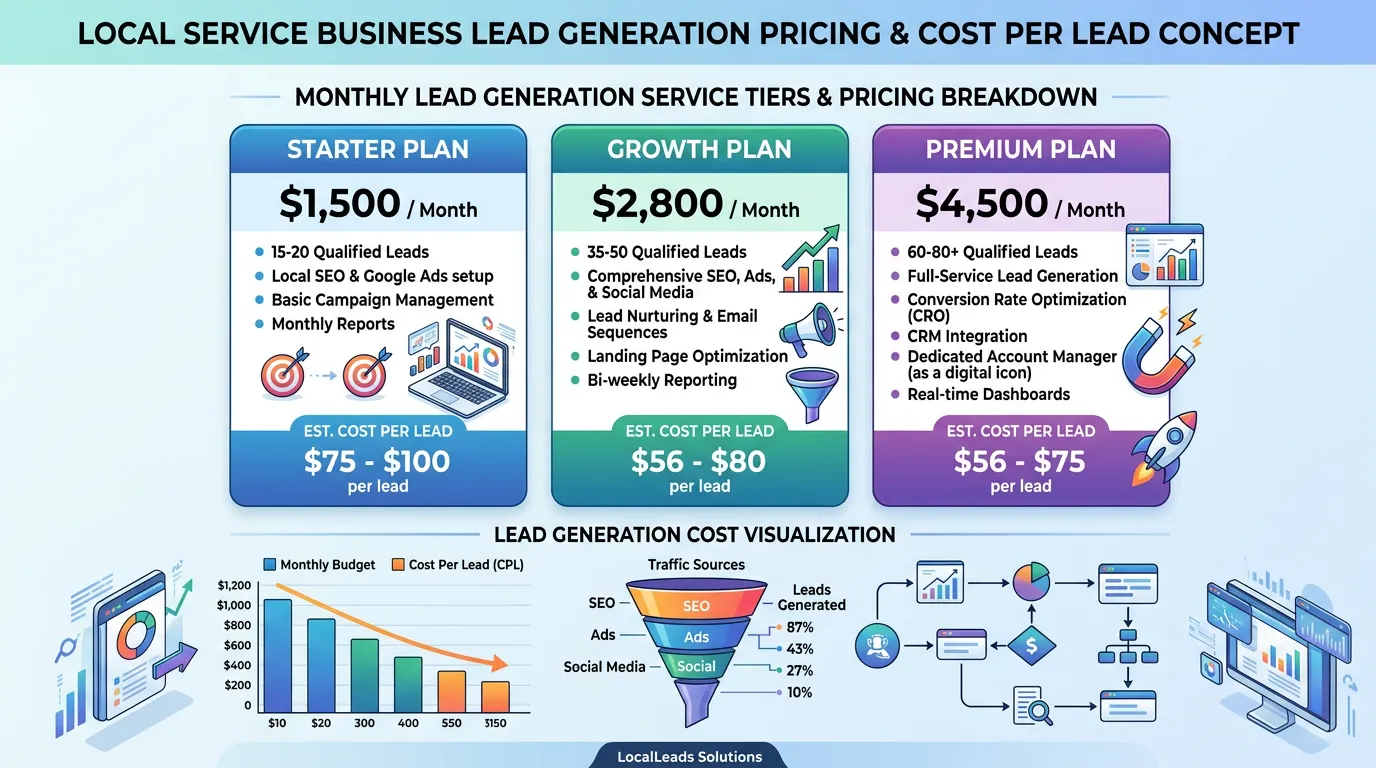
When someone asks what lead generation costs, they usually get one number back, and that number is hiding three very different things. The first is software. Call tracking, a CRM, form tools, scheduling, and email or text automation all carry their own monthly fee. That money goes to the software companies, not to an agency, and the accounts should be in your name. The second is labor. That is the person or team who plans the system, builds it, connects the pieces, and reads the numbers every month. Labor is where quotes vary the most, because two firms can put wildly different amounts of work behind the same sentence. The third is media, which means the ad spend that buys traffic. That money goes to Google or Meta, not to your agency. Ask every bidder to split their proposal into those three columns. A proposal that gives you one blended monthly figure is almost impossible to compare with anything else, and it hides what happens if you cut one part. It also hides the question that matters most later, which is what you keep if the relationship ends. Software in your own name stays with you. Labor stops the day you stop paying for it.
- Software: paid to the tool companies, and you should own the accounts
- Labor: the build, the connections, and the monthly reading of numbers
- Media: ad spend that goes straight to the ad platform
What the Software Actually Costs
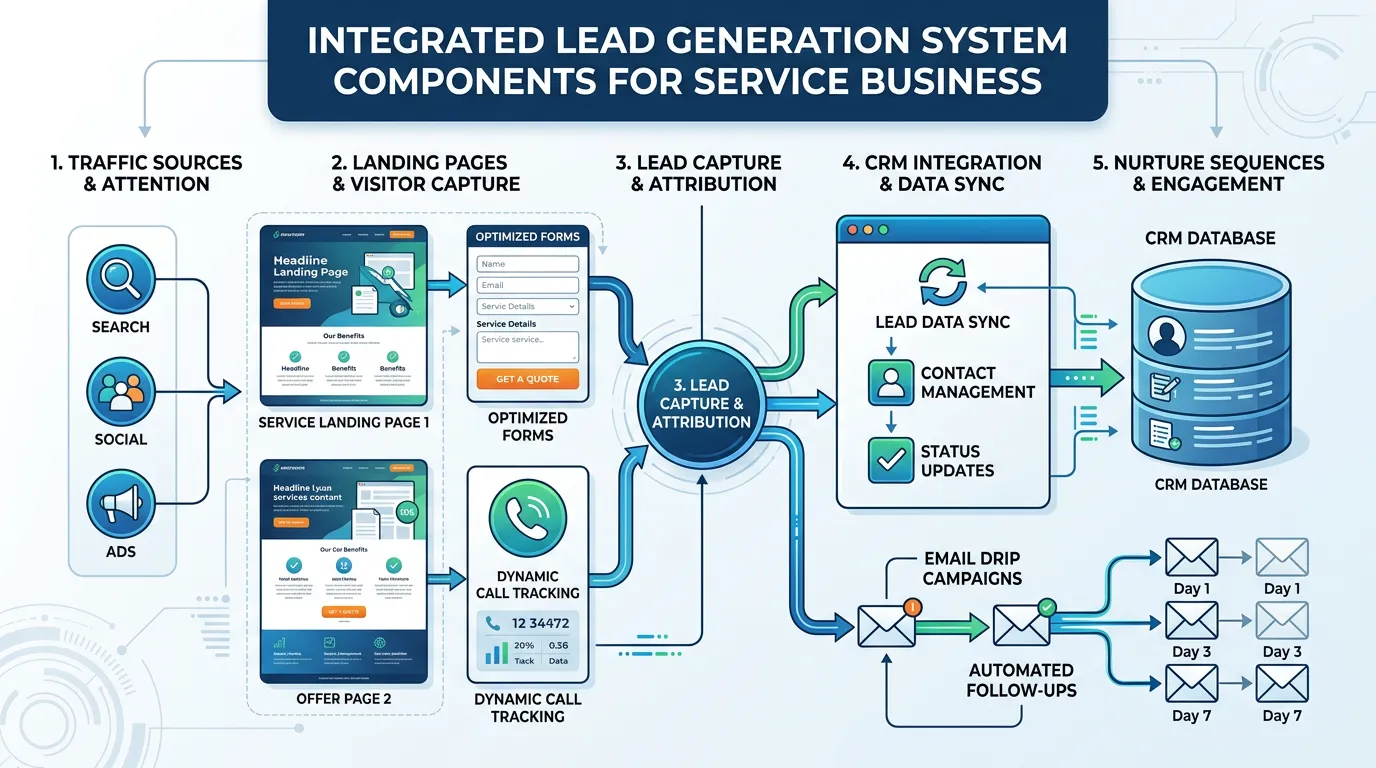
Software is the easiest part to price, because the prices are published on the websites of the companies selling it. Call tracking usually starts near 45 or 50 dollars a month for a small plan and climbs with the number of tracking numbers and the minutes used. A single location business often lands between 50 and 150 a month. A CRM is normally billed per user, and small business tools commonly run from about 30 to 150 per user each month. Field service tools that also handle dispatch, invoicing, and payments sit at the higher end of that. Email and text automation is usually priced by contact count, and many small companies stay under 100 a month for years. Scheduling tools, form tools, and chat widgets are often free or under 50. Add it up and a single location service business commonly spends 100 to 500 a month on software once the system is running. Two things push that number up. Volume is one, because call tracking and messaging tools both bill on usage. Locations are the other, because each site usually needs its own numbers and its own calendar. The good news is that the measurement layer is mostly free. Google Analytics 4 and conversion tracking inside Google Ads cost nothing to use. You pay for the labor to set them up correctly, not for the tools themselves.
The Four Ways This Gets Priced
Almost every quote you receive is one of four shapes, and the shape tells you more than the number does. A build project is a one time fee to install the system: capture fixes, tracking, a CRM connection, and the first automations. It gets quoted like any build, often a few thousand dollars up into the mid five figures, depending on how much already exists. A monthly retainer buys ongoing work: reporting, tuning, new sequences, and somebody to call when a connection breaks. Retainers for a single location service business commonly run from about 1,000 to 5,000 a month. Hourly consulting usually falls between 100 and 250 an hour and suits an owner whose team will do the lead generation work but wants a second opinion before they start. The fourth shape is pay per lead, where you are billed for each lead delivered. It sounds like the safest option and it is usually the messiest, for reasons worth their own section further down. Most service businesses end up with a build fee followed by a smaller retainer, and that matches the lead generation work honestly. The first two months are heavy. Month six is mostly review and small changes. Be careful with a quote that is all retainer and no build. Somebody is either stretching the setup across a year or not doing much of it.
What Pushes a Quote Up
Scope drives price, and scope is mostly counting. Every extra location adds tracking numbers, a calendar, routing rules, and its own line on the monthly report. Going from one site to four does not quite double the lead generation work, but it is not far off. Service lines do the same thing. A company doing plumbing, heating, and drain cleaning needs three sets of screening questions, three follow up sequences, and three sets of numbers to read each month. After hours coverage adds cost, because somebody has to design what happens at 9pm on a Sunday and then test it. Two languages doubles every message you write and every form you build. Messy history is the quiet one. If leads are spread across three inboxes, an abandoned CRM, and a spreadsheet, cleaning and merging that data can take longer than building the new system on top of it. Regulated work adds review time. Medical, legal, and financial businesses need messages that stay inside their rules and consent records that hold up later. An old website can also force extra work into the quote. If forms cannot be edited without a developer, or the phone number is baked into an image, that has to be fixed before anything else works.
- Each extra location and its own set of numbers
- Each extra service line and its own follow up
- Evening and weekend coverage that has to be designed and tested
- A second language across forms, texts, and emails
- Lead history scattered across inboxes and old tools
- Regulated industries where every message needs review
What Pulls a Quote Down
Plenty of things make a quote smaller, and most of them are in your control before you ever ask for one. Already owning a working CRM is the biggest. Connecting to a tool your team opens every day costs far less than choosing, buying, and teaching a new one. One location and one service line keeps the whole build simple. So does a website you can edit yourself, because a form change stops being a developer ticket with a two week wait. Naming one internal owner saves money in a way that surprises people. When there is a person who answers questions, tests the forms, and chases their own team, a project moves in weeks instead of months and the meeting count drops hard. Being willing to start narrow helps too. Fixing capture and response time first, then adding tracking and automation next quarter, spreads the cost and lets the early results help pay for the later work. Clean expectations matter as well. A business that already knows its average job value and close rate skips a whole discovery phase, because the math everyone needs is written down. And if your budget is tight, say the number early. A good vendor will tell you what fits and what has to wait, rather than shrinking the same plan until it stops working.
The Math That Tells You If It Is Worth It
Before you sign anything, do this on one page. Write down your average job value and your gross margin. Say a hypothetical remodeling company averages 9,000 dollars a job at a 35 percent margin. That is about 3,150 dollars of gross profit per job. Now take the whole monthly cost, software plus labor, and divide. If the program costs 2,600 a month, it needs one extra job a month to break even and everything above that is profit. Run the same math for a hypothetical drain cleaning company at 320 dollars a job and a 50 percent margin. That is 160 dollars a job, so an 1,800 dollar program needs about 11 extra jobs a month. Same program, very different answer, and only one of those two should sign. This is also why cost per lead is a weak number on its own. A 40 dollar lead that books one time in ten costs 400 dollars per job. A 90 dollar lead that books one time in three costs 270. The expensive lead is the cheaper job. Ask any vendor to report cost per booked job, not just cost per lead, and agree on what counts as booked before the first month starts.
Common Software Line Items
These are the tools most service businesses end up paying for, with ranges commonly published for small business plans. They are billed to you, not to an agency.
| Tool | What it does | Common monthly range | Who needs it |
|---|---|---|---|
| Call tracking | Ties phone calls back to a source | 50 to 200 | Anyone whose phone rings more than the form |
| CRM | Holds every lead and its history | 30 to 150 per user | Any team where two people touch a lead |
| Email and text automation | Sends follow up without a person | 0 to 200 | Anyone sitting on unsold quotes |
| Scheduling or booking | Lets a customer pick a time | 0 to 100 | Businesses with set appointment slots |
| Analytics and conversion tracking | Records each lead as an event | Free | Everyone, with no exceptions |
Ranges are what small business plans commonly list, not quotes from us. Usage based tools climb as your call and contact volume climbs.
Ask These Before You Sign
Eight questions that separate a real proposal from a good looking one. Any serious vendor answers all of them without stalling.
Split the price three ways
Software, labor, and ad spend on separate lines.
Whose name is on the accounts
Tracking numbers and CRM should be yours.
What is build and what is ongoing
A one time fee should have a finish date.
What counts as a lead
Agree on call length and junk rules first.
Who reports booked jobs
Someone has to close the loop each month.
What happens in month seven
Ask what the lead generation work is once setup is done.
How many hours the retainer buys
Compare hours and outputs, not package names.
What the exit looks like
Notice period, and what you keep after.
Why Pay Per Lead Sounds Fair and Usually Is Not
Paying only for leads feels like the safest deal on the table. You pay for results, not effort. Then month two arrives and the arguing starts.
The fight is always about what counted. A 40 second call from someone asking for a different company. A form from two towns outside your area. A customer of six years who happened to click an ad. Every one of those is a line somebody has to judge, and the person judging it gets paid when the answer is yes.
There is a second problem. Shared leads get sold to you and to two competitors at the same moment, so you pay full price to be one of three callbacks. If you do buy this way, treat it as a traffic source rather than a system, and keep your own tracking so you can check the invoice against reality.
Comparing Two Quotes Without Getting Burned
Two proposals rarely describe the same work. These habits make them comparable before you pick one.
Do this
- Line up hours and deliverables, not package names
- Ask for the software list with prices, then price it yourself
- Get a sample report before you sign, not after
- Put the definition of a lead in writing
- Ask what the first 30 days produce and what month six looks like
Not this
- Do not compare a one time build fee against a monthly fee
- Do not accept ad spend folded into the management fee
- Do not buy a system while your phone rings out during business hours
- Do not sign a twelve month term for work that takes ten weeks to build
- Do not pick on price alone when the cheap bid keeps your tracking numbers
Would rather we handled it?
This article covers how to do the work yourself. If you would rather have it done for you, that is what our lead generation systems service is.
Lead Generation Systems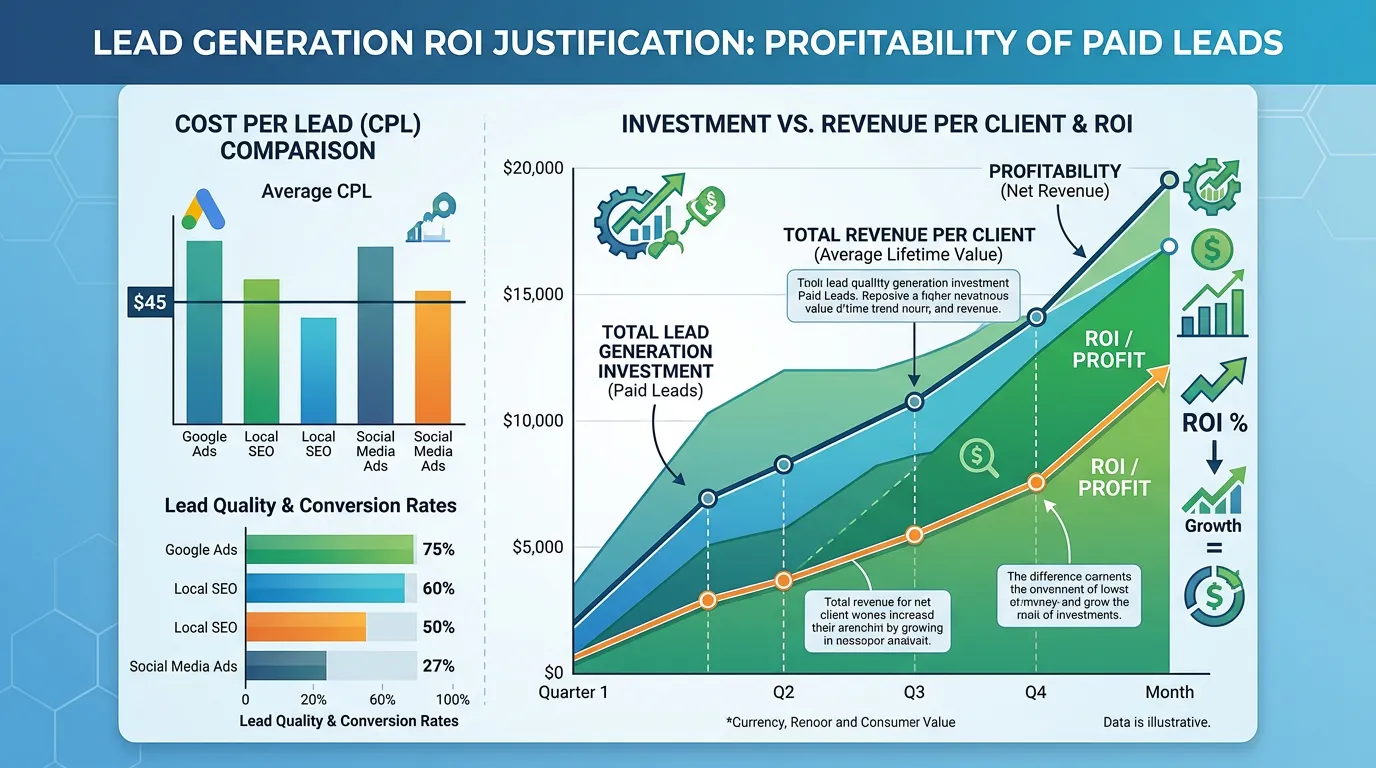
Frequently asked questions
Is this cheaper than buying leads from a marketplace?
How much should a small business spend on this?
Do I have to pay for ads on top of this?
Why do quotes for the same work vary so much?
Sources
- About conversion tracking in Google Ads(opens in a new tab) Conversion tracking inside Google Ads is included with the account, so the measurement layer itself carries no separate software fee.
- Google Analytics 4 events guide(opens in a new tab) Form fills, calls, and bookings are recorded as GA4 events, which is free to use and priced only as setup labor.