
Foundational Guides
How Much Does Technical SEO Cost, and What Changes the Number
The four ways technical SEO gets sold, what each one usually costs, and the seven things that push a quote up or down.
Call (714) 823-3164 or ask a question. Clear recommendations, even if we never work together.
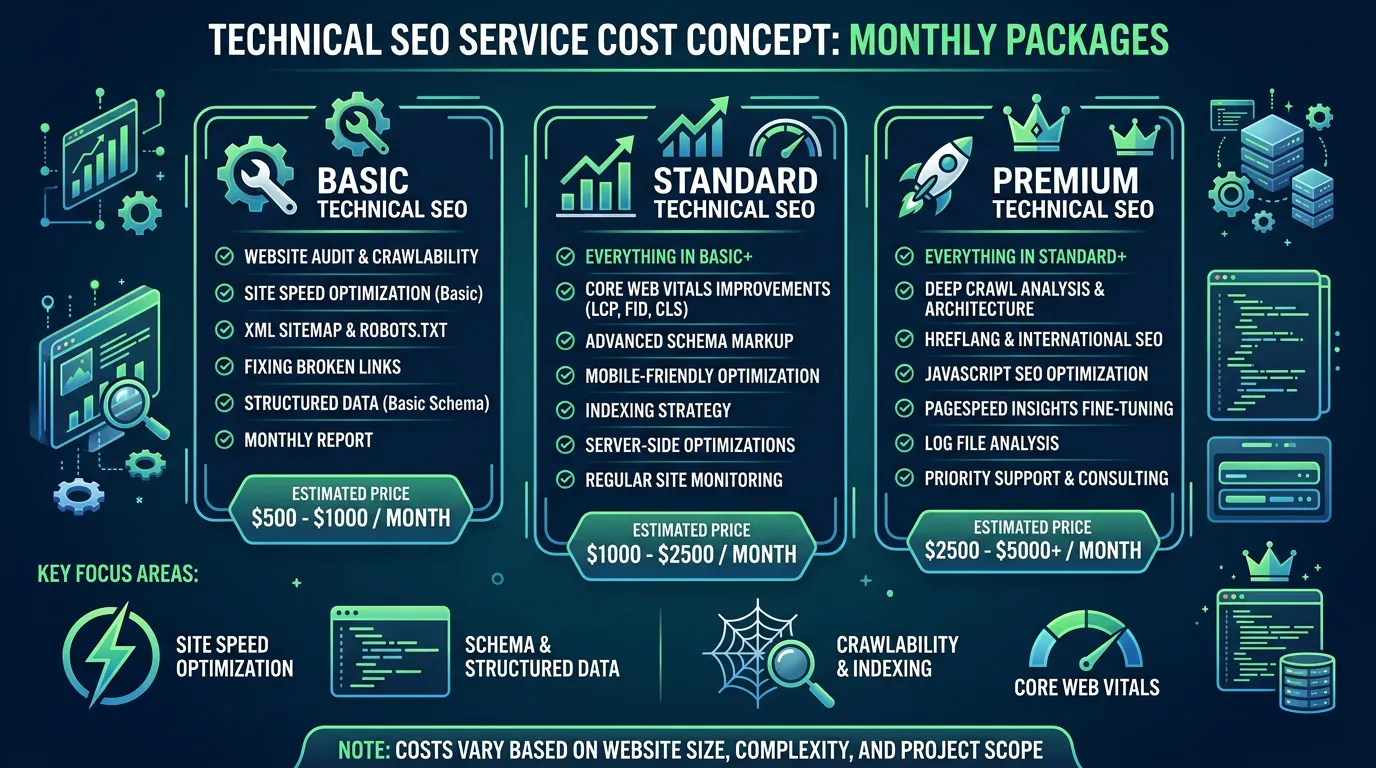
Technical SEO is sold four ways, and each has its own price. A one time audit commonly runs from about 1,500 to 7,500. Ongoing monthly work often falls between 1,000 and 5,000. Hourly help runs roughly 100 to 250. Site size, platform, and who ships the fixes move all of it.
Jump to a section
- The Four Ways Technical SEO Gets Sold
- You Are Paying for Hours, Not Software
- Seven Things That Move a Quote Up or Down
- Ranges You Will Actually See Quoted
- Where Technical SEO Money Gets Wasted
- Costs That Show Up After You Sign
- How to Compare Two Quotes That Look Nothing Alike
- Rough Market Ranges by Type of Engagement
- Ask These Before You Sign Anything
- Buying Technical SEO Without Overpaying
- Three Honest Ways to Spend Less
- Questions
The Four Ways Technical SEO Gets Sold
Technical SEO is sold four ways, and the price only makes sense once you know which one is on the table. A one time audit is a report. Someone crawls your site, reads your Search Console data, and hands you a list of problems in priority order. Nobody fixes anything. An audit plus implementation includes the fixes. That is a project with a start and an end, usually eight to fourteen weeks, and it costs more because someone does the work and tests it. A monthly retainer is ongoing. It covers the first cleanup, then monitoring, checks on new pages, and whatever breaks next. Hourly or fixed project work covers one job. A migration, a speed pass on one template, or schema across a set of pages. Owners get burned most often on the first option. They buy a report, assume the fixes come with it, and find out months later that nothing shipped. Ask which of the four you are buying before you ask what it costs. The answer can change the number by five times.
You Are Paying for Hours, Not Software
Almost all of the cost is skilled hours. Tools are real but small. A crawler license and a couple of monitoring subscriptions run a few thousand a year across every client a shop has. That is not what you are paying for. Here is where the hours go on an audit of a hundred page site. Setting up and running the crawl takes two to three hours. Pulling and cleaning a year of Search Console data takes another two. The crawl output is the easy part. Reading it against the real site, deciding what actually matters, and throwing out the four hundred warnings that do not, takes ten to twenty hours. Writing the findings as instructions a developer can follow takes about ten more. That is roughly thirty to forty hours of experienced time, and that is where audit pricing comes from. When you see a two hundred dollar audit, you are looking at a tool export with a cover page. The crawl ran. The thinking did not.
Seven Things That Move a Quote Up or Down
You can estimate your own range before anyone calls you back. Page count is the obvious factor, but templates matter more. A thousand page site built from six templates is often less work than a ninety page site where every page was built by hand. Platform is next. WordPress and Shopify have known fixes and known limits. A custom build or a headless setup means every change goes through a developer. Rendering matters too. If your site draws itself with JavaScript, testing takes longer and more things break. History is the quiet one. A site that changed domains twice and got redesigned three times carries old redirects and dead URLs that all need untangling. Who ships the fixes may be the biggest lever of all. If your own developer implements the tickets, you pay for diagnosis only, and the price can drop by a third or more. Last is access. When every change waits on a corporate queue or a franchise approval, add weeks and hours to the estimate.
Ranges You Will Actually See Quoted
Here are the ranges quoted around this market, so you can tell a normal number from a strange one. A one time audit on a small site, under about a hundred pages, commonly runs from 1,500 to 3,000. A mid sized site with several templates and a messy history runs 3,000 to 7,500. Large sites go past that, sometimes well past. An audit plus the fixes, delivered as a project, often lands between 5,000 and 25,000 depending on how much shipping is involved. Ongoing monthly work usually falls between 1,000 and 5,000 a month, and the top of that range assumes the agency is also implementing. Hourly rates for experienced technical help run about 100 to 250. Two honest notes. Prices move with region and with who is doing the work, so a Southern California shop and a solo consultant elsewhere will not quote the same. And a low number is not automatically bad. A short audit from someone good, on a small clean site, can be exactly the right buy.
Where Technical SEO Money Gets Wasted
Some of this spending buys nothing, and the patterns repeat. The first is the ninety page PDF. It is a tool export with a logo on it, sorted by the tool's idea of severity, which rates a missing meta description on a thank you page the same as a canonical tag pointing your whole blog at the homepage. Nobody can act on it. The second is the retainer where nothing ships. Month after month of monitoring, reporting, and recommendations, with no changes made because the developer never got the tickets. If three months pass and you cannot name one change that went live, you are paying for a newsletter. The third is a rebuild you did not need. Sometimes a rebuild is right. Often the site is fine and four specific fixes would do it. Get a second opinion before replacing something that mostly works. The fourth is tool licenses you never open. Ask what happens to those accounts when the engagement ends.
Costs That Show Up After You Sign
A few real costs sit outside the quote and surprise people later. Developer hours are the big one. If the agency writes tickets and your developer ships them, that is time on their invoice, often ten to thirty hours across a project. Hosting is second. Some speed problems are hosting problems, and no amount of image work saves a server that takes two seconds to answer. Better hosting might add 50 to 300 a month. A content delivery network is usually cheap and sometimes free. Plugin licenses for caching or image handling run maybe a hundred a year. A staging environment may be included in your hosting or may not. Content edits are the sneaky one. When the fix for near duplicate city pages is rewriting nine of them, that is writing, and writing is billed separately almost everywhere. Ask about each of these during the quote. A shop that answers plainly is showing you how it works.
How to Compare Two Quotes That Look Nothing Alike
Two quotes for the same site can differ by four times and both be honest. The gap is almost always scope, so compare scope, not price. Ask what the deliverable is. A ranked list of issues with the affected URLs and clear acceptance criteria is a real deliverable. A file of tool warnings is not. Ask who implements. Ask what happens after the fixes ship, since verification takes weeks and someone has to watch the reports. Ask what gets measured and when it gets reported. Indexed page counts, field speed data, and impressions are the honest early measures. Calls come later. Then ask the uncomfortable question. What would you tell me not to buy? A shop willing to say your site is mostly fine, or that you need content before you need technical work, is worth more than one that finds four hundred urgent problems on every site it opens. That answer tells you more about the next year than the price does.
Rough Market Ranges by Type of Engagement
Ranges you will commonly see quoted. Treat them as a sanity check on a proposal, not as a price list.
| Engagement | What you get | Common range | Best fit |
|---|---|---|---|
| One time audit | A ranked list of problems | 1,500 to 7,500 | You already have a developer |
| Audit plus fixes | Diagnosis and shipped changes | 5,000 to 25,000 | Nobody in house can ship |
| Monthly retainer | Cleanup, then monitoring | 1,000 to 5,000 a month | Sites that change often |
| Hourly help | One named task, done | 100 to 250 an hour | One template or one question |
| Migration plan | Redirect map and checks | Low thousands, flat | A domain or platform change |
The biggest single swing is who implements. Diagnosis only, with your team shipping, sits near the bottom of every row.
Ask These Before You Sign Anything
Seven questions that separate a proposal you can hold someone to from one you cannot.
Which of the four shapes is this?
Audit, audit plus fixes, retainer, or hourly.
Who implements each fix?
Your team, their team, or split by type.
What does the deliverable look like?
Ask to see a sample with URLs in it.
Which four numbers get measured?
Recorded before work starts, not after.
How many hours is this scoped at?
Rough is fine. Refusing to say is not.
What is outside the scope?
Content, dev time, hosting, licenses.
What do we own when it ends?
Tickets, data, accounts, and documents.
Buying Technical SEO Without Overpaying
The cheapest quote and the best value are rarely the same line item. These habits protect both.
Do this
- Pay for diagnosis and fixes as one job when you can
- Use your own developer for shipping if you have a good one
- Fix the template once instead of the pages one at a time
- Record your starting numbers before the first change goes live
- Start with one audit before committing to a year of retainer
Not this
- Do not buy a report with no plan for who acts on it
- Do not judge a proposal by page count of the deliverable
- Do not pay for a rebuild until a second opinion agrees
- Do not accept severity ratings straight from a tool export
- Do not sign a twelve month term before seeing one month of work
Three Honest Ways to Spend Less
Narrow the scope on purpose. You do not need every page audited. Pick the templates that carry your money pages, fix those, and let the rest wait a quarter. Template work spreads across many URLs at once, so this is usually the best value in the whole category.
Do the free checks first and bring the results. An owner who arrives with the Page Indexing report, three PageSpeed results, and a list of the pages that matter saves several hours of discovery. Some shops will price that in, and all of them will scope faster.
Say no to the work that is not technical. If your quote includes content rewrites, link building, and design changes, split them out and price them separately. Bundles hide which part is working and make it hard to stop the part that is not.
Would rather we handled it?
This article covers how to do the work yourself. If you would rather have it done for you, that is what our technical seo service is.
Technical SEO
Frequently asked questions
Is a technical SEO audit worth it if I have no developer?
Why do agencies quote monthly for what sounds like a project?
Can I do the basic technical work myself?
How do I know the work was worth what I paid?
Sources
- Google Search Central: Do You Need an SEO?(opens in a new tab) Google's own advice on hiring, including questions to ask before signing.
- Google Search Central: SEO Starter Guide(opens in a new tab) The baseline work an owner can reasonably do without paying anyone.
- Google Search Console Help: Page Indexing report(opens in a new tab) The free report used to record starting numbers before work begins.
- PageSpeed Insights(opens in a new tab) Free field and lab speed data for any public page, used as a baseline.