
Foundational Guides
How Much a Small Business Website Costs, and What Moves the Number
What a website really costs across the market, which line items move the quote, and the yearly bills nobody mentions.
Call (714) 823-3164 or ask a question. Clear recommendations, even if we never work together.
A small business website usually costs between about 2,000 and 30,000 dollars to build, depending on scope. Page count, custom design, writing, photography, and integrations move the number most. Plan for yearly costs too. Hosting, the domain, licenses, and upkeep commonly run a few hundred to a few thousand dollars a year.
Jump to a section
- Why Two Quotes for the Same Site Differ by Ten Times
- What You Are Actually Paying For
- The Six Things That Push a Quote Up
- What Brings a Quote Down Without Wrecking the Site
- The Yearly Costs Nobody Puts in the Proposal
- When Cheap Is Fine, and When It Is Not
- Rough Market Ranges for a Small Business Site
- Why the Cheapest Quote Often Costs the Most
- How to Read a Website Quote
- Budget Questions Owners Ask Late
- Questions
Why Two Quotes for the Same Site Differ by Ten Times
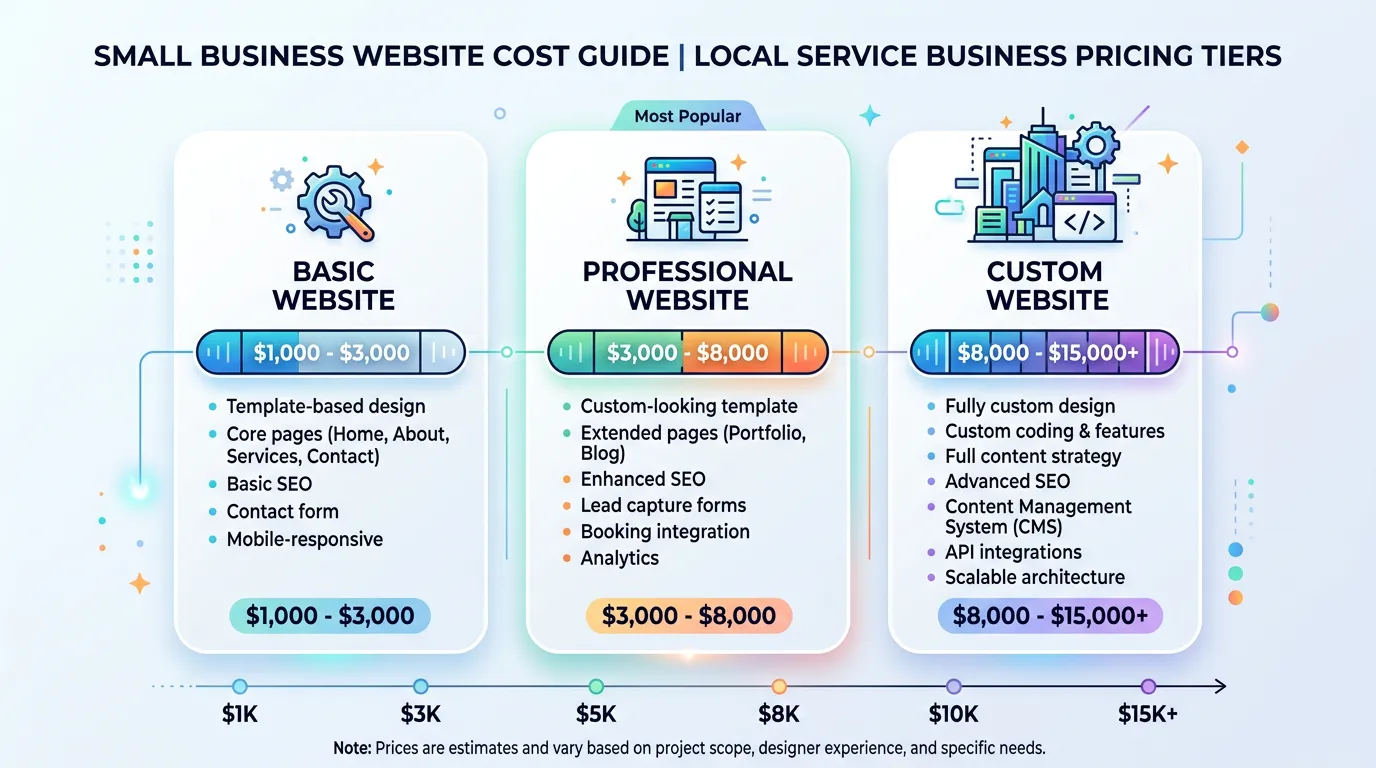
Ask three companies to build the same site and you can get 3,000, 12,000, and 40,000 dollars back. That is not one of them being dishonest. They are quoting different work. The cheap quote usually means a template, your old text pasted in, and no research. The middle quote means a custom design, a person writing the pages, and testing on real phones. The high quote adds photography, video, booking or payment tools, or a build across several locations. A website is not a product with a shelf price. It is a stack of hours. The only fair way to compare quotes is to compare what sits inside them. Two quotes that both say website redesign can hide a five times gap in hours. Line the items up and the spread usually shrinks. What is left is a real choice about scope, not a mystery.
What You Are Actually Paying For
Most of a website budget is people thinking, not people typing code. On a normal build the hours split roughly like this. Planning and discovery take about ten percent, covering interviews, the sitemap, and deciding what each page must say. Design takes twenty to thirty percent. Writing takes fifteen to twenty five percent, and it is the part clients underestimate most. The build takes thirty to forty percent. Testing, launch, and redirects take the rest. Notice that the coding is under half. This is why a fifteen page site does not cost three times a five page site. Discovery happens once. The design system gets made once. Page eleven costs far less than page one, because it uses a template that already exists. That also explains why adding one odd page late costs more than it looks, since it needs its own design and its own build. If your budget is tight, cut page count and one off layouts before you cut writing or testing.
The Six Things That Push a Quote Up
Six things move a quote more than anything else. Page count is the obvious one, though it matters less than people think once templates exist. Custom design is next. A one off layout for every page costs several times a system reused across pages. Content is third, and it is the most common surprise. If someone has to interview you and write twelve pages, that is real hours. Integrations are fourth. Booking, payments, a portal, or a live tie in to your job software each add work, and each add something that can break later. Migration is fifth. Moving off a platform that hides your content is slow, dull, and costly. The sixth is anything with a compliance angle. Medical, legal, and financial sites need extra review steps. Access work for people using screen readers adds scope too, and it is worth doing. Photography sits alongside all six. A half day shoot is not free, and stock photos cost you trust instead of money.
- Page count, though templates flatten this fast
- One off layouts instead of one reused system
- Who writes the words, you or them
- Booking, payment, or customer portal tools
- Migrating off a platform that fights you
- Compliance review and access work
What Brings a Quote Down Without Wrecking the Site
There are honest ways to spend less. Cut the page count to what you can keep current. A tight eight page site beats a stale thirty page site every time, and you can add pages later. Reuse one template across your service pages instead of asking for a different look on each. Do the raw content yourself. You do not need to write well. You need to answer questions out loud while someone records it. Sit down for forty five minutes per service and talk through what customers ask, what you charge for, and what goes wrong on a job. A writer turns that into good pages. It is the research that costs, not the typing. Take your own photos of real jobs on a decent phone in daylight, and hand over a hundred of them. Push integrations to a second phase. Launch, get calls, then add online booking when you know people want it. What you should not cut is testing, redirects, and tracking. Those are cheap during the build and expensive after.
The Yearly Costs Nobody Puts in the Proposal
The build is one number. Running the site is another, and it never stops. Your domain runs roughly 15 to 60 dollars a year. Hosting ranges from about 100 dollars a year for shared space to a few thousand for managed hosting with real support. Paid themes and plugins add up quietly. Five licenses at 80 dollars each is 400 dollars a year, and letting them lapse means no security updates. Email is usually separate now, at a few dollars per user per month. Then there is upkeep. Someone has to apply updates, take backups, and fix what shifts. That is either your time or a support plan. Budget for changes too, because prices change, staff change, and you add services. A site nobody edits looks stale in about eighteen months. For a small service business, a fair yearly total is a few hundred dollars at the low end and a few thousand with managed hosting and a support plan. Knowing that number in advance stops year two from feeling like a trick.
When Cheap Is Fine, and When It Is Not
Cheap is fine more often than agencies admit. If you are one person testing whether a trade even works, a template site you build in a weekend is a sensible move. Spend two hundred dollars, get a phone number and three real photos on a page, and see what happens. That beats a ten thousand dollar site for a small business you might not keep. Cheap stops being fine at a clear point. If the site is your main source of work, or you spend on ads that land there, a template is now costing you jobs quietly. The tell is usually speed and structure. If the phone number is not tappable, if the page takes eight seconds on cell data, if one page lists nine services, you are leaking. The other place cheap fails is the very low monthly build. A site for 99 dollars a month often means you never own it. Read who holds the domain, the files, and the content if you stop paying.
Rough Market Ranges for a Small Business Site
Prices you will see quoted around the market for a build. Treat this as a sanity check, not a price list.
| Type of build | Common one time range | What it usually includes | Where it falls short |
|---|---|---|---|
| Do it yourself | Under 500 | A template and your own hours | Speed, structure, and time |
| Freelance template | 1,500 to 5,000 | A theme, light edits, your text | Little research or writing |
| Small agency custom | 6,000 to 20,000 | Design, writing, build, launch | Needs your time and photos |
| Larger custom build | 20,000 to 60,000 | Photos, tools, many pages | Overkill for one location |
| Monthly site plans | 99 to 400 a month | A site while you keep paying | You may never own it |
The gap between rows two and three is mostly research, writing, and testing, where most of the result lives.
Why the Cheapest Quote Often Costs the Most
A 1,500 dollar site is not the same site at a lower price. It is a different amount of work. At that number nobody is interviewing you, writing twelve pages, or testing on real phones.
What you usually get is a theme with your logo dropped in and your old text pasted over. It beats nothing, and for a brand new business it is often the right call.
The cost shows up later. You pay again in eighteen months when it needs replacing, and in the meantime through calls that went to a competitor whose page loaded faster.
There is a fair version of a small budget. Pay a professional for the structure, the writing, and the launch, then run the site yourself. Splitting the small business work by who is best placed to do it beats buying a cheap version of everything.
How to Read a Website Quote
Two quotes can use the same words and mean very different work. These questions separate them.
Do this
- Ask for a page count, and what three extra pages would cost.
- Ask who writes the words, then ask to read a page they wrote.
- Ask how many rounds of design changes are included.
- Ask what the plan is for your old web addresses and redirects.
- Ask what you own at the end: domain, files, content, photos.
Not this
- Do not compare on price until the scope lines up item by item.
- Do not assume photography is included. Get it in or out in writing.
- Do not sign a monthly plan without reading what you keep if you stop.
- Do not pay extra for a promise of a search position. Nobody can promise one.
- Do not let tracking, testing, or redirects be the thing you cut.
Budget Questions Owners Ask Late
Should I pay monthly or once?
Is a template site always a bad idea?
How much should I hold back for after launch?
Would rather we handled it?
This article covers how to do the work yourself. If you would rather have it done for you, that is what our web design and development service is.
Web Design and Development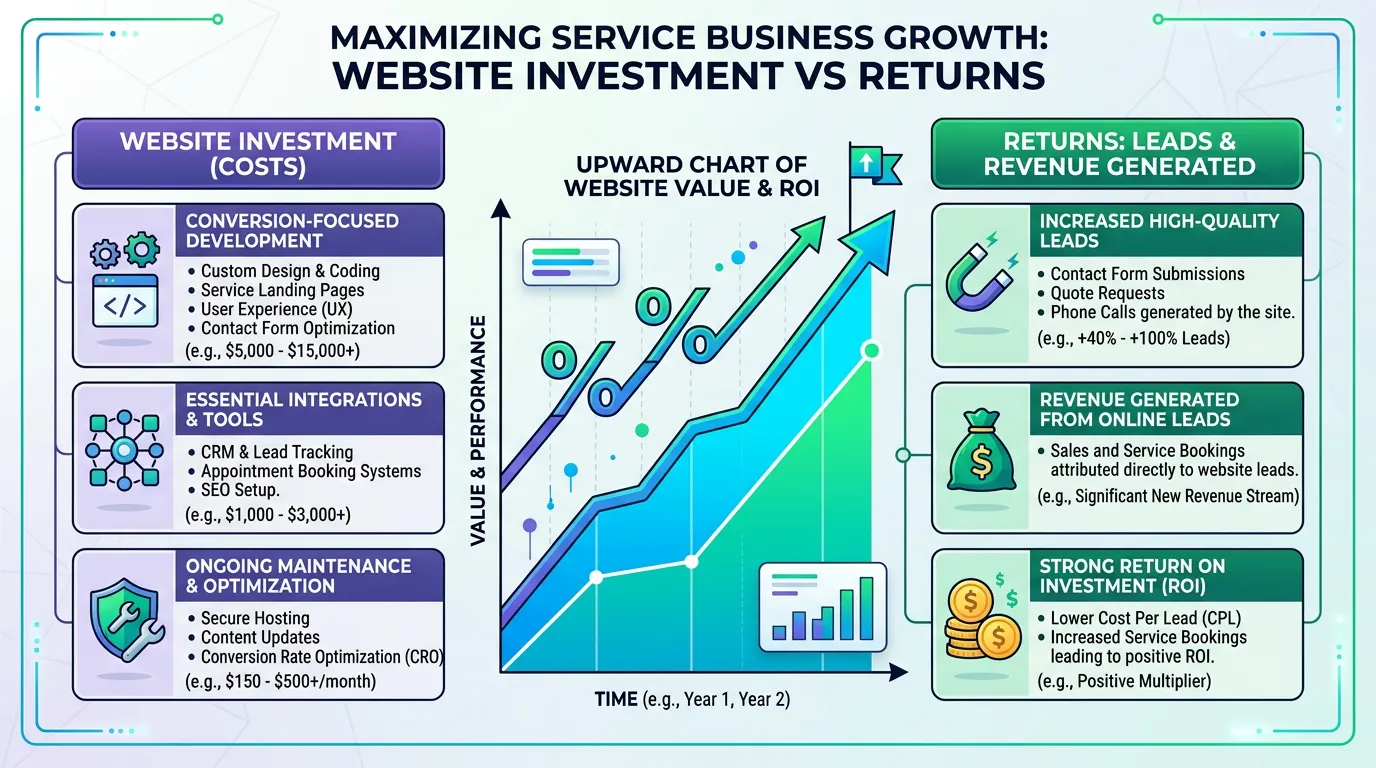
Frequently asked questions
Why do so few agencies put website prices on their site?
Is a fixed price or an hourly rate better?
Does a redesign cost less than building new?
What should I expect to pay for the writing alone?
Sources
- Google Search Central: Redirects and Google Search(opens in a new tab) Why a rebuild needs a redirect plan, which is a real line item in any quote.
- ADA.gov: Guidance on Web Accessibility and the ADA(opens in a new tab) Why access work adds scope to a website build for many businesses.
- W3C: Web Content Accessibility Guidelines(opens in a new tab) The standard most accessibility line items in a quote are measured against.