
Foundational Guides
What a Marketing Consultant Costs, and What Moves the Price
Five ways consultants charge, the ranges you will actually see quoted, and the six things that move the number up or down.
Call (714) 823-3164 or ask a question. Clear recommendations, even if we never work together.
Marketing consultants are commonly quoted between about 100 and 350 dollars an hour, or a few hundred to a few thousand dollars a month on retainer. Fractional CMO work runs higher. The price moves with how many channels and vendors you have, how often you talk, and how much access you want between calls.
Jump to a section
- The Five Ways Consultants Charge
- Six Things That Push a Quote Up
- What Pulls a Quote Down
- What the Cheap End Really Buys
- Hourly or Monthly, and When Each Is Right
- Doing the Math on Whether It Pays
- How to Compare Two Proposals That Look the Same
- What You Will See Quoted, by Model
- Why Two Quotes for the Same Hours Differ by Three Times
- How to Read a Consulting Proposal
- What Should Be Named in the Price Before You Sign
- Questions
The Five Ways Consultants Charge
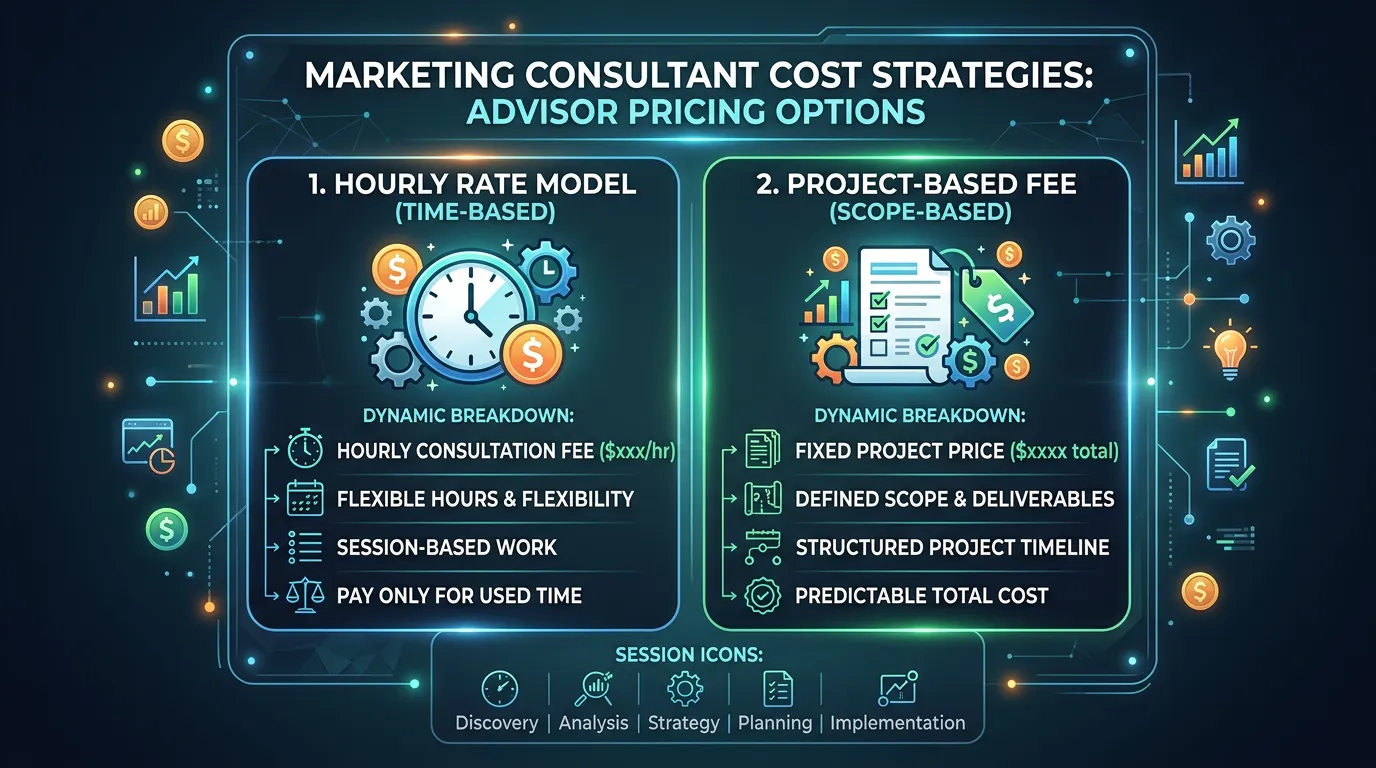
Advice gets sold five ways, and the model changes what you are really buying. Hourly is the simplest. You pay for time, and the meter runs. It works for a one off question and fails as an ongoing plan, because you start saving up questions to avoid the bill. That is the opposite of what you want. Day rates and half day rates cover a workshop or a deep review. You get somebody's full attention for a block of time, usually with a written output at the end. Project pricing covers a one time audit or a written plan. There is a fixed scope, a fixed fee, and a document at the finish. Monthly retainers are the common shape for ongoing advice. You pay a flat fee for a scheduled call plus some level of access between calls. Retainers cost more per hour than hourly work, and the extra buys continuity. The person answering already knows your close rate and your busy season. Fractional CMO arrangements sit at the top. You buy set days per month and real authority over the plan. Some consultants also offer performance or equity deals. Those are rare in small service businesses, and they get complicated fast when nobody agrees on what counts as a result.
Six Things That Push a Quote Up
Six things move an advisory price more than your company size does. Channel count is first. Overseeing one Google Business Profile and one small ads account is a different job from overseeing ads, organic, email, social, and a site rebuild at once. Vendor count is second, and it compounds. Every vendor adds a report to read, a call to sit in, and an invoice to sanity check. Three vendors is not three times one vendor. It is more, because they contradict each other. Locations are third. Multi location businesses need the same review done several times with different local numbers. Access is fourth, and it is the quiet driver. A monthly call is one price. A monthly call plus same day answers to email and text is another, because the consultant is holding capacity for you all month. Depth of reporting is fifth. Reading a dashboard somebody else built is cheap. Building the measurement so the numbers are trustworthy is a project. Meeting attendance is sixth. Sitting in your vendor calls, or presenting to a partner group, costs real hours. Any two of these can double a quote, which is why two businesses of the same revenue get very different numbers.
- How many channels are under review each month
- How many vendors and reports have to be read
- How many locations need their own numbers
- Whether between call access is included and how fast
- Whether measurement gets built or just read
- Whether they attend your vendor or team meetings
What Pulls a Quote Down
You control more of this price than you think. Narrow the scope on purpose. Ask for oversight of the two channels that actually produce work, and leave the rest alone for now. Fewer things reviewed well beats everything reviewed shallowly, and it costs less. Cut the meeting count. A monthly call with a tight agenda often replaces a weekly check in that had nothing new in it. Get your numbers in order before you start. If close rate, average job value, and lead source are already tracked, nobody bills for the archaeology. Send a real agenda ahead of the call. Ten minutes of prep from you saves half the call. Batch your questions when you can, since three small ones handled together take less time than three separate rounds. Give access on day one instead of drip feeding it. Chasing logins is billable and pointless. Accept a slower reply window if your business does not need a same day answer. Many owners pay for speed they never use. And skip the presentation layer. A written summary in an email costs less than a designed report, and nobody is going to frame either one.
What the Cheap End Really Buys
There is a floor below which nobody is doing the marketing work you think you are paying for. Do the math on a very low monthly advisory fee. After a call, notes, and reading one report, that is barely an hour of anybody's time. Nobody is reviewing your ad account line by line for that. What you usually get is a friendly conversation and a repeat of general advice you could read anywhere. The truly cheap version is worse. It is free, and it is a sales meeting. The advice is shaped like the marketing service the person sells, which is why every free audit finds exactly the problem that vendor fixes. There is a fair version of a small budget, though. Pay once for a real audit and a written plan, then execute it yourself for six months. That splits the work by who is best placed to do each part, and it is honest about the fact that you cannot afford ongoing oversight yet. Another fair version is a quarterly call instead of a monthly one. What does not work is a low monthly fee attached to the word unlimited. Unlimited access at a low price means one of two things. Either nobody expects you to use it, or the person selling it has too many clients to answer anyone properly.
Hourly or Monthly, and When Each Is Right
Pick the model that matches how your questions arrive. Hourly is right when questions are rare and big. You have one contract to review this quarter, or one decision about a rebrand. Pay for the hours, get the answer, and stop. Hourly is wrong when questions arrive weekly, because the billing changes your behavior. Owners on hourly plans batch up questions until the important one has already been decided by default. That is the expensive failure nobody sees on an invoice. Monthly is right when the value is in continuity and speed. If a proposal lands on a Thursday and needs an answer Monday, you want somebody already holding your context. Monthly is wrong when you are between projects and have nothing to decide, which happens more than people admit. Say so and pause it. Project pricing is right for anything with a clear finish line, like a plan, an audit, or a vendor selection. Watch for the mixed model that quietly costs the most, which is a small retainer plus hourly for anything real. That looks cheap on the proposal and does not stay cheap. Ask what falls inside the retainer and what triggers extra hours, in writing, before you sign.
Doing the Math on Whether It Pays
The math is simpler than most people make it. Take your average job value and your close rate on quoted work. Now ask how many extra booked jobs a year the advice needs to cause to cover the fee. For a business where a job is worth a few hundred dollars, an advisory fee has to change something structural to pay for itself, and it usually cannot at a low volume. For a business where one job is worth several thousand dollars, one saved decision covers months of it. These are made up examples, not clients. Take a hypothetical plumber with three vans, mostly repair work and a few repipes. Most of the value here is not new leads. It is not renewing an ad contract that was quietly producing nothing, and getting the estimate follow up fixed. Now take a hypothetical dental office adding implant cases. One case is worth a lot, so the whole question is whether the advice improves how those inquiries are handled. Now a hypothetical remodeling firm running three vendors at once. The payoff there is coordination and knowing which vendor to keep. Notice that in all three the payoff is a stopped mistake, not a new channel. Price the advice against that, not against a hoped for growth number.
How to Compare Two Proposals That Look the Same
Two advisory proposals at the same price can mean very different things. Ask exactly what access you get between calls, and what reply time is promised. Ask who does the marketing work. Many firms sell you a senior name and staff the calls with someone else, which is fine if you meet that person first. Ask what is in the monthly deliverable. Notes with owners and dates is a real answer. A report is not. Ask how vendor reviews are handled and whether a written second opinion is included or billed apart. Ask whether they sell services they might recommend, and how they handle that conflict. There is a right answer, and it is not a denial. It is a clear rule about when they step out of the room. Ask what happens if you want work done. If oversight starts turning into execution, does the fee change or does the advice quietly stop. Ask for a decision record so ideas do not cycle back every year. Ask about notice. Thirty days is normal for advice. Finally, ask what they would refuse to help with. A vendor who does everything either has not thought about it, or is about to do all of it badly.

What You Will See Quoted, by Model
These are ranges commonly quoted in the market, not our prices and not a promise. Use them as a sanity check on a proposal you are holding.
| How it is priced | Range commonly quoted | What that usually covers | When it fits |
|---|---|---|---|
| Hourly | About 100 to 350 an hour | Answers to specific questions | Rare, one off decisions |
| Day or half day rate | About 800 to 3,000 a day | A workshop plus a written output | One planning session |
| One time audit or plan | About 1,500 to 10,000 | Findings and a written plan | You have never had a plan |
| Monthly retainer | About 500 to 5,000 a month | A call plus access between calls | Ongoing vendor oversight |
| Fractional CMO | About 3,000 to 15,000 a month | Set days and real authority | You have a team to lead |
The wide range inside every row is access and channel count, not the consultant's postcode. Ask what sits at the low end of their own range.
Why Two Quotes for the Same Hours Differ by Three Times
Ask two advisors for a monthly call and a proposal review, and the quotes can come back three times apart. Both can be honest.
The cheaper one is priced for a call and a look at whatever you send. Nobody is opening your ad account in between. The dearer one is priced for holding capacity all month, reading vendor reports before you do, and keeping a running record of decisions.
The hours on the call match. What surrounds the call does not. One answers the question you asked. The other notices the question you did not think to ask.
The right question is not which is cheaper. It is whether your decisions arrive on a schedule or at random. Scheduled questions suit the cheap version fine. Random ones do not.
How to Read a Consulting Proposal
Advisory proposals hide their real cost in the access terms. These questions pull two look alike documents apart.
Do this
- Ask what reply time is promised between calls, in writing.
- Ask who actually attends the calls, then meet that person.
- Ask what triggers extra hours on top of the retainer.
- Ask for a sample of the monthly notes, with names redacted.
- Ask how they handle it when they also sell the marketing work they recommend.
Not this
- Do not buy unlimited access at a low price. Something has to give.
- Do not pay for a designed report you will never read twice.
- Do not sign a year for advice. Thirty days notice is normal.
- Do not accept a promise of leads or rankings at any price.
- Do not compare on hourly rate alone. It hides pattern count.
What Should Be Named in the Price Before You Sign
Each line below needs a real answer in the proposal. A missing answer is a cost that turns up later.
Call length and frequency
A number, not the word regular.
Reply time between calls
Same day, next day, or none.
Who attends
Named person, not a firm name.
Vendor proposal reviews
Included, or billed per review.
Channels covered
List them. Everything means nothing.
What counts as extra work
The line that triggers more hours.
The monthly deliverable
Notes with owners and dates.
Notice period
Thirty days is normal for advice.
Would rather we handled it?
This article covers how to do the work yourself. If you would rather have it done for you, that is what our marketing consulting service is.
Marketing Consulting
Frequently asked questions
Why is one consultant 100 an hour and another 350?
Should I pay for a plan or a monthly retainer first?
Is a fractional CMO worth it for a small service business?
What should never be extra on the invoice?
Does a consultant cost less than hiring a marketer?
Sources
- Google Search Central: Do you need an SEO?(opens in a new tab) Google sets out what to ask a search vendor before hiring, including scope, reporting, and contract terms, and warns against anyone guaranteeing rankings.
- Google Search Central: SEO Starter Guide(opens in a new tab) Google explains how it finds, crawls, and indexes pages, and covers the basics of titles, descriptions, headings, and links that any plan should already handle.
- About conversion tracking in Google Ads(opens in a new tab) Conversion tracking inside Google Ads is included with the account, so the measurement layer itself carries no separate software fee.