
Foundational Guides
How Much Content Marketing Costs, and What Moves the Price
The three ways content gets priced, the six things that move the number, and how to tell a fair quote from a cheap one.
Call (714) 823-3164 or ask a question. Clear recommendations, even if we never work together.
Most service businesses spend between a few hundred and a few thousand dollars a month on content. A single researched article is commonly quoted between 150 and 800 dollars, and full monthly programs run higher. The price moves with research depth, how competitive the topic is, and how much of the expertise you supply yourself.
Jump to a section
- The Three Ways Content Gets Priced
- Six Things That Push a Quote Up
- What Pulls a Quote Down
- What the Cheap End Really Buys
- Doing It Yourself, and What That Really Costs
- How Much to Budget, by Size of Shop
- How to Compare Two Quotes That Look the Same
- What You Will See Quoted, by Model
- Why Two Quotes for the Same Article Differ by Five Times
- How to Read a Content Quote
- What Should Be Named in the Price Before You Sign
- Questions
The Three Ways Content Gets Priced
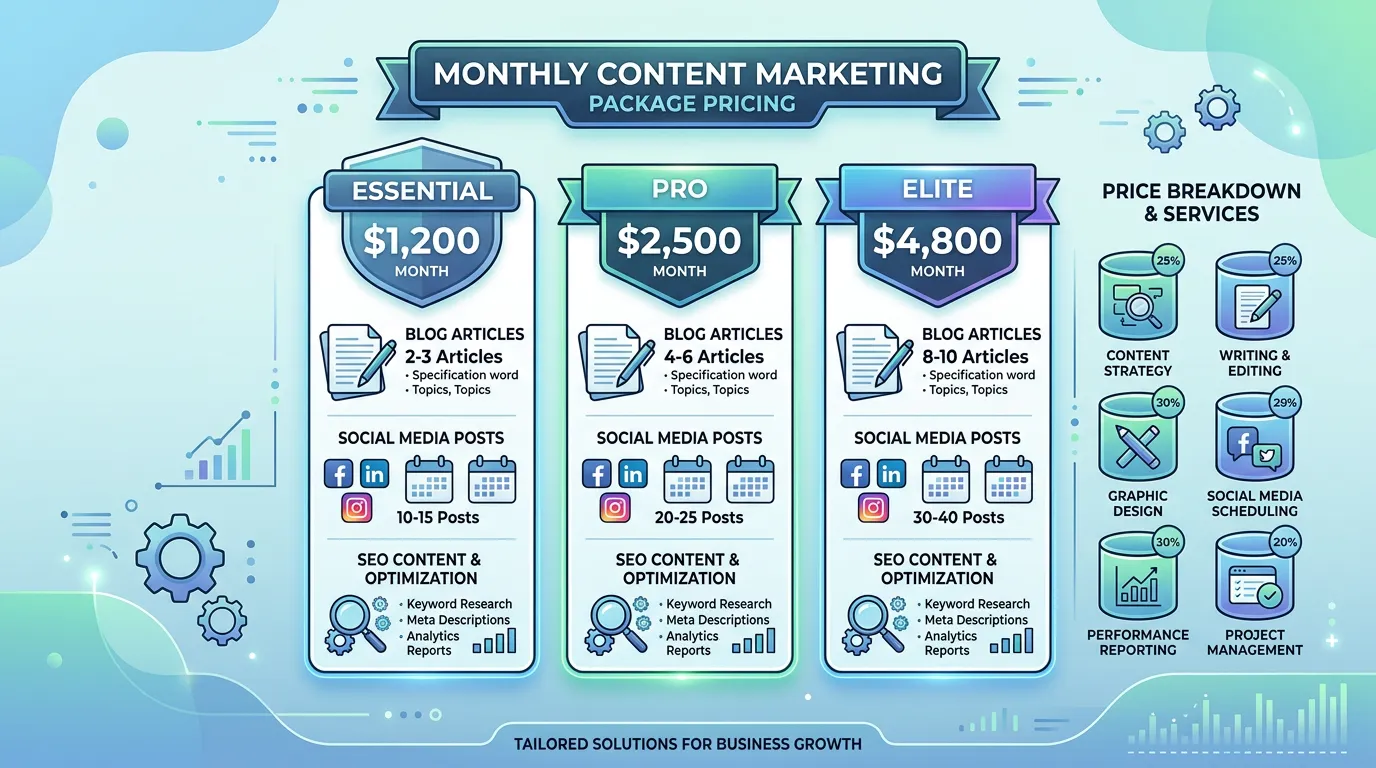
Content is sold three ways, and the model changes what you are really buying. Per word is the oldest. A writer quotes a rate for each word, and you will see anywhere from ten cents to a dollar and up. The trouble with per word pricing is that it pays for length, not for research. Nobody gets paid extra for the phone call to your foreman that made the page worth reading. Per piece is cleaner. You agree on a price for one finished article at a set depth, and the writer owns the time it takes. A short, lightly researched piece and a deeply researched one get quoted as different products. That is honest, and it is easy to compare. Monthly retainers are what most agencies sell. You pay a flat fee and get an agreed set of work, usually a few pieces plus planning, editing, images, links, and a report. Retainers cost more per article than a freelance rate, and the extra pays for the parts a writer does not do. Whether that extra is worth it depends on who is doing the thinking. If you already know exactly what to publish and just need words, a retainer is expensive. If you do not, it is the cheaper option.
Six Things That Push a Quote Up
Six things move a price more than anything else. Research depth is first. A page built from three other blog posts takes an hour. A page built from a call with your service manager, a look at real invoices, and a check of your city permit rules takes a day. Same word count, very different cost. Competition is second. If the top results for your question are 3,000 word guides with custom diagrams, matching them costs real money. If the top results are thin, you can win with less. Subject matter time is third, and it cuts both ways. It costs the writer time to run and edit an interview, but it is the one thing that makes a page hard to copy. Custom art is fourth. Diagrams, tables built from your own numbers, and photos of your crew all add cost and all raise trust. Planning is fifth. Somebody has to decide which questions are worth answering. Paying for that once is cheap. Skipping it is how owners end up with forty posts and no leads. Revisions are sixth. Two rounds is normal. Open ended editing is not, and any quote that allows it is quietly priced for it.
- Research depth, from a quick rewrite to a day of real digging
- How strong the pages you have to beat already are
- Time with your own experts, and who edits that into the page
- Custom images, diagrams, and tables built from your numbers
- Whether topic planning is included or billed apart
- How many rounds of edits the price covers
What Pulls a Quote Down
You have more control over the price than you think. Supply the expertise yourself. Thirty minutes on a recorded call each month saves the writer hours of research and makes the page better at the same time. That is the biggest lever most owners never pull. Narrow the scope. Ask for fewer pieces with more depth. Four thin posts cost more than two good ones and do less. Batch the content marketing work. Six articles about one service, planned at once, share the same research, so the fifth costs less to make than the first. Six articles about six unrelated services share nothing. Give clear feedback fast. A draft that sits for three weeks and comes back with vague notes gets rewritten twice. A draft returned in two days with specific corrections gets fixed once. Reuse what you already have. Old estimates, warranty sheets, training notes, and the email you send every week to explain the same thing are all raw material. Hand those over on day one. Last, commit to a run of months rather than a single test article. Nobody can price six months of learning your trade into one piece.
What the Cheap End Really Buys
There is a floor below which nobody is doing the content marketing work you think you are paying for. Do the math on a fifty dollar article. At a fair hourly rate that is about an hour of somebody's time, and that hour has to cover research, writing, editing, and loading it into your site. Nobody is calling your foreman for an hour of pay. What you get is a summary of what already ranks, which is exactly the page a search engine has no reason to show. Google lists scaled content abuse in its spam policies, which covers making a lot of pages mainly to game rankings rather than to help a reader. That is the cheap end in one line. The real cost is not the wasted fee. It is the year you spent believing content does not work for your trade. There is a fair version of a small budget, though. Pay once for a plan and a strong template, write the drafts yourself, and pay an editor to fix them. That splits the content marketing work by who is best placed to do each part. What does not work is a low monthly fee for a job that needs a person and a real conversation with your crew.
Doing It Yourself, and What That Really Costs
Free is not free. Say you write one 1,500 word article a month yourself. Research, drafting, editing, images, and loading it in is a realistic full day, more if writing is not something you enjoy. Price your own day at what you bill and compare that number to a quote. For a lot of owners the do it yourself version turns out to be the expensive one. Hiring in house is a different question. A full time content person is a salary plus payroll costs plus tools, and one person cannot do planning, writing, design, and search work well. In house makes sense when you publish a lot, in one trade, for years. It rarely makes sense at two pieces a month. There is a middle option that works well and gets ignored. You record voice notes about the jobs you finished this week. Somebody else turns those into pages. You spend twenty minutes and you get content nobody else on earth could write. That mix is usually the best value on the table. It is worth asking any vendor whether they can work that way before you compare prices at all.
How Much to Budget, by Size of Shop
These are made up shops, not clients, and they are here to show how the math scales. Take a plumber with three vans in the Inland Empire. Most work is repair, some is repipes and water heaters. Two well researched pages a month, aimed at the cost and comparison questions for the bigger jobs, is enough to build a real library inside a year. That is a small monthly number, and the whole thing lives or dies on whether the owner gives up half an hour a month. Now take a dental office with two chairs that wants implant cases. Implants get researched hard, and the pages you have to beat are long and detailed. This office needs fewer topics but far more depth on each one, plus real photos and honest price bands. The right budget there is higher per piece and lower in count. Last, take a remodeling firm covering most of Orange County. Competitors publish constantly, the jobs are large, and one extra project pays for a year of work. That is the case for a bigger program with a main guide, a full set of supporting pages, and a refresh cycle. Match the spend to the value of one job, not to what a blog is supposed to cost.
How to Compare Two Quotes That Look the Same
Two proposals at the same price can mean completely different things. Ask what the word count and research depth is per piece, and who does that research. Ask whether topic choice and planning sit inside the price or get billed apart. Ask how many rounds of edits you get before extra fees start. Ask who writes it, and whether you can read a sample by that person rather than the agency's best writer from three years ago. Ask if images and diagrams are included or extra. Ask whether internal links and on page setup are part of the job, because a page nothing links to takes far longer to work. Ask who owns the pages if you leave. Ask what happens in month seven, once the first push is finished, since a plan with nothing after setup is really a setup fee spread across a year. Finally, ask what they will not do. A vendor who says they do everything either has not thought about it or is about to do all of it badly. The most useful answer in a sales call is usually an honest no.
What You Will See Quoted, by Model
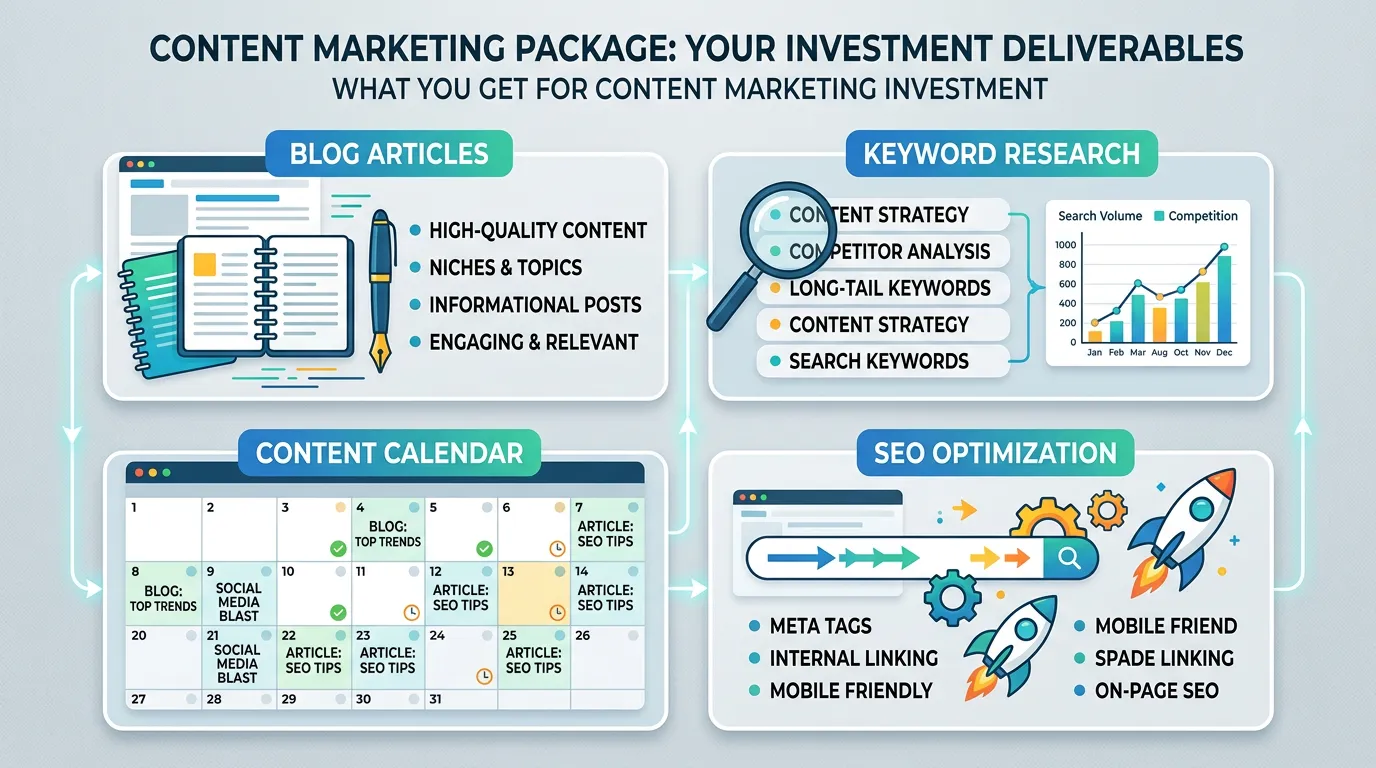
These are ranges commonly quoted in the market, not our prices and not a promise. Use them as a sanity check on a bid you are holding.
| How it is priced | Range you will see quoted | What that usually covers | Where it falls short |
|---|---|---|---|
| Per word | About 10 cents to 1 dollar | A draft at an agreed length | Pays for length, not research |
| Per finished piece | About 150 to 800 a page | Draft, edit, one revision | You still pick the topics |
| Monthly retainer | About 1,000 to 8,000 a month | Plan, write, edit, links, report | More per article than freelance |
| Full time in house | A salary plus tools | One person doing all of it | One person cannot do it all well |
| Bulk content mills | Under 100 a page | A rewrite of what already ranks | Rarely earns a single visit |
The gap between rows two and five is where most disappointment lives. Under 100 dollars a page does not buy a phone call with your crew.
Why Two Quotes for the Same Article Differ by Five Times
Ask two vendors for a 1,500 word page on furnace replacement cost and the quotes can come back five times apart. Both can be honest.
The cheap one is priced for a writer reading the top five results and rewriting them. The expensive one is priced for a call with your install lead, a look at real invoices, a check of local permit fees, and a table built from your own numbers.
The word count matches. The page does not. One repeats what a reader could already find. The other carries numbers nobody else can publish.
The right question is not which quote is cheaper. It is whether the expensive version is needed for that topic. For a crowded cost question it usually is. For a simple how it works page, it usually is not.
How to Read a Content Quote
Two proposals can look the same on paper and mean different things. These questions pull them apart.
Do this
- Ask what research goes into one piece, and who actually does it.
- Ask for a sample written by the person who would write yours.
- Ask whether topic choice and planning sit inside the price.
- Ask how many rounds of edits are included before extra fees.
- Ask who owns the pages, images, and briefs if you walk away.
Not this
- Do not buy on word count. A long thin page is still a thin page.
- Do not pay for a promise of any ranking. Nobody can promise one.
- Do not sign a year with a vendor you have never worked with.
- Do not accept pageviews as the only number in the report.
- Do not cut the planning line to save money. It is the cheap part.
What Should Be Named in the Price Before You Sign
Every line below should have a real answer in the proposal. A missing answer is a cost that shows up later.
Word count and depth per piece
A number, not the word thorough.
Who does the research
A writer, a strategist, or you.
Subject matter time
How many minutes a month you owe.
Rounds of edits included
Two is normal. Ask what a third costs.
Images and diagrams
Included, billed extra, or your job.
Internal links and page setup
Titles, headings, links on publish day.
Reporting
Which numbers, how often, in what form.
What happens after month six
New pages, refresh work, or nothing.
Would rather we handled it?
This article covers how to do the work yourself. If you would rather have it done for you, that is what our content marketing service is.
Content Marketing
Frequently asked questions
Why do two prices for the same word count differ so much?
Is a cheap article better than no article?
Should I pay per article or pay monthly?
How much should I budget for the first six months?
Does AI writing make content cheaper?
Sources
- Google Search Central: Spam policies for Google web search(opens in a new tab) Google lists scaled content abuse, which covers generating many pages mainly to manipulate rankings rather than to help people.
- Google Search Central: Creating helpful, reliable, people-first content(opens in a new tab) Google describes the self assessment questions it uses to judge whether content is original and adds value beyond what other pages already say.
- Google Search Central: SEO Starter Guide(opens in a new tab) Google covers the basics that any published page needs, including useful titles, descriptions, headings, and links between pages.