Marketing Consulting
Growth Planning Sessions
Half day working session that ends with a written quarterly plan
- Timeline
- One half day session, roughly three to four hours, with a week of preparation beforehand and the written plan delivered within two business days
Call (714) 823-3164 or ask a question. Clear recommendations, even if we never work together.
A growth planning session is a focused working meeting, usually a half day, that sets your next quarter of marketing priorities. The owner and the team review recent results, then pick two or three things to pursue. Each priority gets a named owner and a date. You also write down what would count as success.
The problem
Growth planning meetings in small companies tend to end with enthusiasm and no plan. Everyone agrees things should improve, six ideas get discussed, nobody writes down who does what, and the next meeting starts with the same six ideas plus one new one. Part of the reason is that the owner runs the meeting while also being the person with the most to say, so nothing gets challenged and nothing gets cut. Part of it is that these conversations happen at the end of a long day when everyone wants to leave. The result is a company that talks about growth quarterly and executes on it never.
What it is
This is a facilitated working session with a fixed agenda and a written output. We prepare first. We pull the last quarter's numbers, list what was committed last time and what actually happened, and draft a short list of candidate priorities. In the room, the first hour is honest review. That includes the things that did not get done, because skipping that is how the same commitments repeat forever. The second block is choosing, and choosing means saying no to good ideas. That is where an outside facilitator earns their keep. We cap it at two or three priorities, because a small team cannot do more than that alongside their day jobs. Each priority gets a named owner, a date, and a first step small enough to start this week. Each one also gets a success bar, written before the growth planning work begins. The last block covers what could stop each priority and what to do about it. You leave with a one page plan and calendar invitations for the check ins. Sessions run in person around Chino and the Inland Empire, or over video.
Signs you need this
- Your growth planning meetings end with agreement and no assignments
- The same three projects have been on the list for a year
- Your team is busy and cannot say what they are working toward
- You just finished a strategy document and need to convert it into a quarter

What is included
- Pre session data pull covering last quarter's spend, leads, and booked work
- Accountability review of what was committed last time versus what shipped
- Facilitated priority selection with an explicit not doing list
- Two or three priorities with named owners, dates, and first steps
- Written success bar for each priority, set before work starts
- Risk and blocker list with a mitigation for each
- One page quarterly plan delivered within two business days
- Check in calls scheduled at 30 and 60 days to keep it alive
Our process
Prepare the material
Week before the sessionWe pull the numbers, list last quarter's commitments and their status, and draft candidate priorities so the session starts with facts instead of forty minutes of people trying to remember what happened.
Review honestly
Session hour 1First hour covers what worked, what did not, and what never got started. Undone items get a real reason, usually a lack of time or a missing dependency, and that reason shapes what gets committed to this time.
Choose and cut
Session hour 2Candidate priorities get argued and cut down to two or three. Everything rejected goes on a written not doing list, which prevents the good idea from reappearing in three weeks and quietly consuming someone's Thursday.
Assign owners and success bars
Session hour 3Each priority gets a person, a date, a first step small enough to start within a week, and a stated definition of success. Priorities without a willing owner get dropped in the room rather than dying quietly later.
Follow up at 30 and 60 days
Day 30 and day 60Two short calls to check progress and clear blockers. Most quarterly plans fail in week three, so a call at day thirty catches the stall while there is still time to do something about it.
Realistic timeline: One half day session, roughly three to four hours, with a week of preparation beforehand and the written plan delivered within two business days. Check ins at 30 and 60 days. Most clients run these quarterly, though twice a year is workable for businesses with a slower cycle.
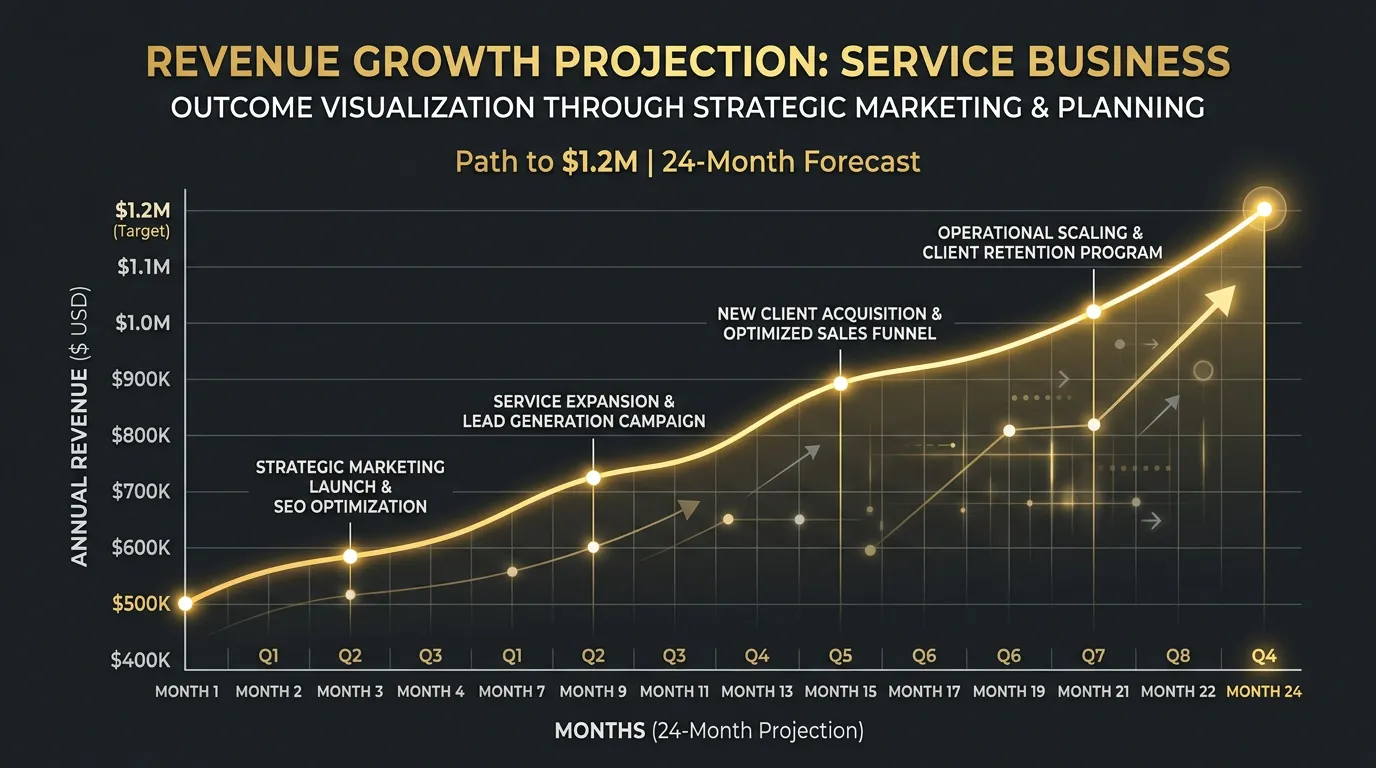
How the Half Day Actually Runs
The agenda is fixed and the timings matter. Sessions that drift end with good feelings and no assignments.
Roughly three and a half hours with one break. The cutting block is the one everybody wants to skip, and the one that does the growth planning work.
Writing a Success Bar You Cannot Argue With Later
A success bar is one sentence, written before the growth planning work starts, that says what would count as this working. Most plans skip it. Then the quarter gets graded by feel, and the loudest person in the room wins.
Here is the difference. A vague bar reads: improve our Google presence. A useful bar names a number and a date. Say the profile brings 26 calls a month today. The bar reads: 40 calls a month by March 31.
The test is simple. Could two people who disagree about everything still agree on whether the bar was met? If not, it is not written yet.
Set the bar from your own numbers, not from what sounds impressive in the room. A target you invented to feel ambitious teaches you nothing when you miss it, because you never knew what was reachable.
Rules That Keep the Room Honest
The hard part is not building the plan. It is keeping a room honest for three hours while the person who signs the checks is sitting in it. These rules do most of that job.
Do this
- Put last quarter's undone items on the wall before anything new gets discussed
- Have the owner speak last on each item so the room says what it really thinks
- Write the not doing list somewhere everyone can see it all day
- Give every priority a first step that fits inside one afternoon
- Book the day 30 call before anybody leaves the room
Not this
- Do not run this at four in the afternoon after a full workday
- Do not let a priority stand without a person who says yes to owning it
- Do not take on more work than your slowest week of the quarter allows
- Do not invite people who have no part in any of the outcomes
- Do not end without a written page, because a photo of a whiteboard is not a plan
Where Quarterly Plans Stall, Week by Week
Plans rarely fail at the end of a quarter. They fail on a fairly predictable schedule, and each stall has a cheap fix if you catch it.
| When | What it looks like | Real cause | The fix |
|---|---|---|---|
| Week 1 | Nothing starts | The first step was too big | Cut it to one afternoon |
| Week 3 | The owner goes quiet | Busy season swallowed it | Move the date, keep the goal |
| Week 5 | Waiting on a vendor | No written scope or date | Send a one page brief |
| Week 8 | A new idea takes over | Nobody enforced the no list | Park it until next quarter |
| Week 11 | Nobody knows the score | The numbers were never agreed | Check the success bar early |
| Day 60 | Half done and moving | This one is fine | Leave it alone |
The day 30 call exists because week three is when most of this first shows up.
A quarterly plan is mostly a list of things you agreed not to do. The two or three left standing are the plan.