Comparison
SEO vs PPC
Search engine optimization compared with Pay per click advertising
Call (714) 823-3164 or ask a question. Clear recommendations, even if we never work together.
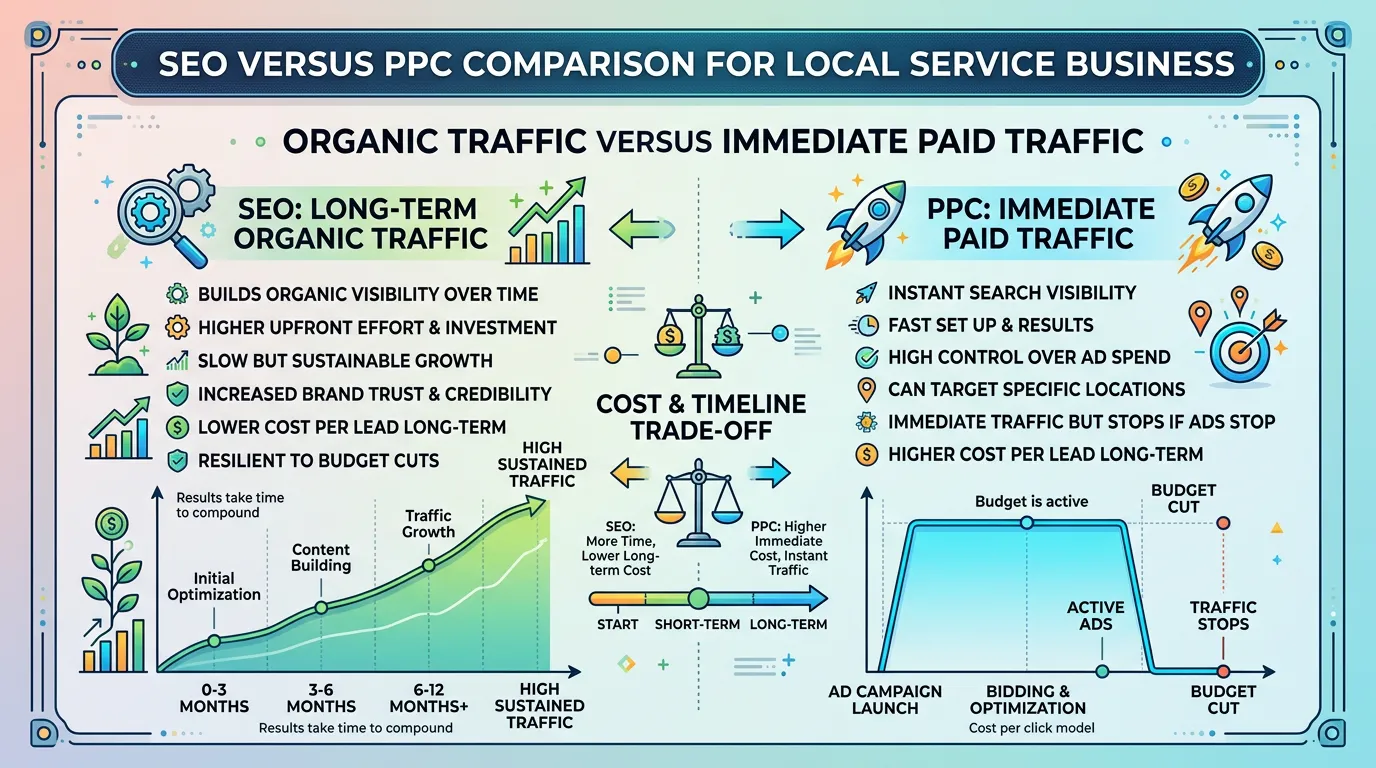
SEO earns free clicks over months and keeps working after you stop paying. PPC buys clicks today and stops the moment the budget runs out. PPC wins on speed and testing. SEO wins on cost per lead over time. Most service businesses run PPC first, then let SEO take over the volume.
Our honest verdict
If you need calls this month, PPC is the honest answer and SEO is not. If you want a lower cost per lead in year two, SEO is the honest answer and PPC is not. Running both is common, because each one covers the other's weak spot. Do that only when the budget can feed both without starving either. Under about $2,000 a month total, pick one and do it properly.
Side by side
| Criterion | Search engine optimization | Pay per click advertising |
|---|---|---|
| Time to first lead | 60 days at the earliest, and often 4 to 6 months before volume is steady. | Same day. Approve a campaign in the morning and take calls that afternoon. |
| Cost per lead over time | Falls as rankings hold. The same page keeps producing at no extra click cost. | Flat or rising. Every lead costs money, and click prices climb most years. |
| What happens when you stop | Traffic fades over months, not overnight. Pages, reviews, and links stay. | The phone stops the day the card declines. Nothing carries over. |
| Control over targeting | Limited. Google decides who sees you, from where, and for which words. | Precise. You set keywords, radius, hours, devices, and daily budget. |
| Speed of testing | Slow. A headline or page change takes weeks before the data means anything. | Fast. Offers, headlines, and landing pages can be tested in days. |
| Trust from the searcher | Map and organic results carry more weight with plenty of buyers. | The sponsored label costs you clicks, especially with older customers. |
| Predictability | Hard to forecast. An algorithm update can move you without warning. | Spend maps to leads within a fairly tight range once you have data. |
| Handling a seasonal spike | Cannot be turned up in July because a heat wave arrived. | Raise budget Monday, cut it Friday, repeat as the weather changes. |
| Total monthly investment | $1,500 to $4,000 in fees, with no click costs on top. | Management fee plus ad spend. Most trades need $2,000 or more in clicks to learn anything. |
| Emergency and urgent searches | The map pack takes most emergency calls once you rank in it. | Local Services Ads sit above everything else and charge per lead. |
| What you own at the end | Pages, rankings, reviews, and links stay with the business. | You rent the placement. Nothing accumulates from month to month. |
| Data for the rest of your marketing | Search Console shows what people ask, slowly and with gaps. | Search term reports show exactly what buyers type and which words convert. |
A plus marks the side with the advantage on that row. If one column won every row, this would be an advertisement rather than a comparison.
When Ads Are the Right Answer Forever
Some businesses should never spend a dollar on SEO. That is not a popular thing for an agency to write, so here is the list.
If you plan to sell the business in under two years, ads turn into cash now and SEO probably will not finish paying you back. Say your work is entirely emergency, like a lockout or a burst pipe. Most of that demand goes to whoever sits at the top when the panic starts, and paid placements sit there. And if you are testing a new city before you commit, ads tell you in three weeks whether the demand is real.
Seasonal businesses belong here too. A pool heater company that earns most of its money in a ten week window can turn spend up and down with the weather. SEO cannot be turned up in October because a cold snap arrived.
The reverse case is just as real. If your trade has $60 clicks and your average job is $300, paid search may never work for you at all. Then earning the click is the only path, and that means SEO.
Work Out Your Own Crossover Point
Nobody can tell you when SEO gets cheaper than ads for your business. You can work it out in twenty minutes with numbers you already have.
| Step | What to pull | Where it lives |
|---|---|---|
| 1. Paid cost per lead | Ad spend plus fees, divided by leads | Google Ads conversions |
| 2. Close rate on paid leads | Booked jobs divided by leads | Your CRM or job board |
| 3. Paid cost per booked job | Step 1 divided by step 2 | Simple math |
| 4. Monthly SEO fee | The flat number you pay | Your invoice |
| 5. Organic leads last month | Calls and forms from search and maps | Analytics and profile insights |
| 6. Organic cost per lead | Step 4 divided by step 5 | Simple math |
| 7. Repeat every month | Watch step 6 fall while step 1 holds | A one page spreadsheet |
The month step 6 drops below step 1 is your crossover. It is your number, not an industry average.
Before You Spend a Dollar on Ads
Every item here is cheaper to fix before the spend starts than after. Skipping them is how owners end up deciding that ads do not work.
Conversion tracking that fires on calls and forms
Without it you are guessing which words paid you.
A tracked phone number with call recording
Half of local leads are calls. Untracked calls are invisible.
A landing page that matches the ad
Sending drain cleaning clicks to a homepage wastes half of them.
A negative keyword list on day one
Block jobs, salary, free, DIY, and trades you do not sell.
Ad hours set to when someone answers
A missed call at 9pm costs the same as one you booked.
A budget floor you can hold for ninety days
Stopping at week three teaches you nothing at all.
A clear number for what a booked job is worth
You cannot judge a $90 lead without knowing that.
Where Paid Money Actually Leaks
Most owners blame the click price. The bigger losses sit further down, and those are yours to fix.
A campaign tuned only at the top keeps paying for leads that the rest of the funnel drops.