
Comparison
Reputation Management vs Ignoring Reviews
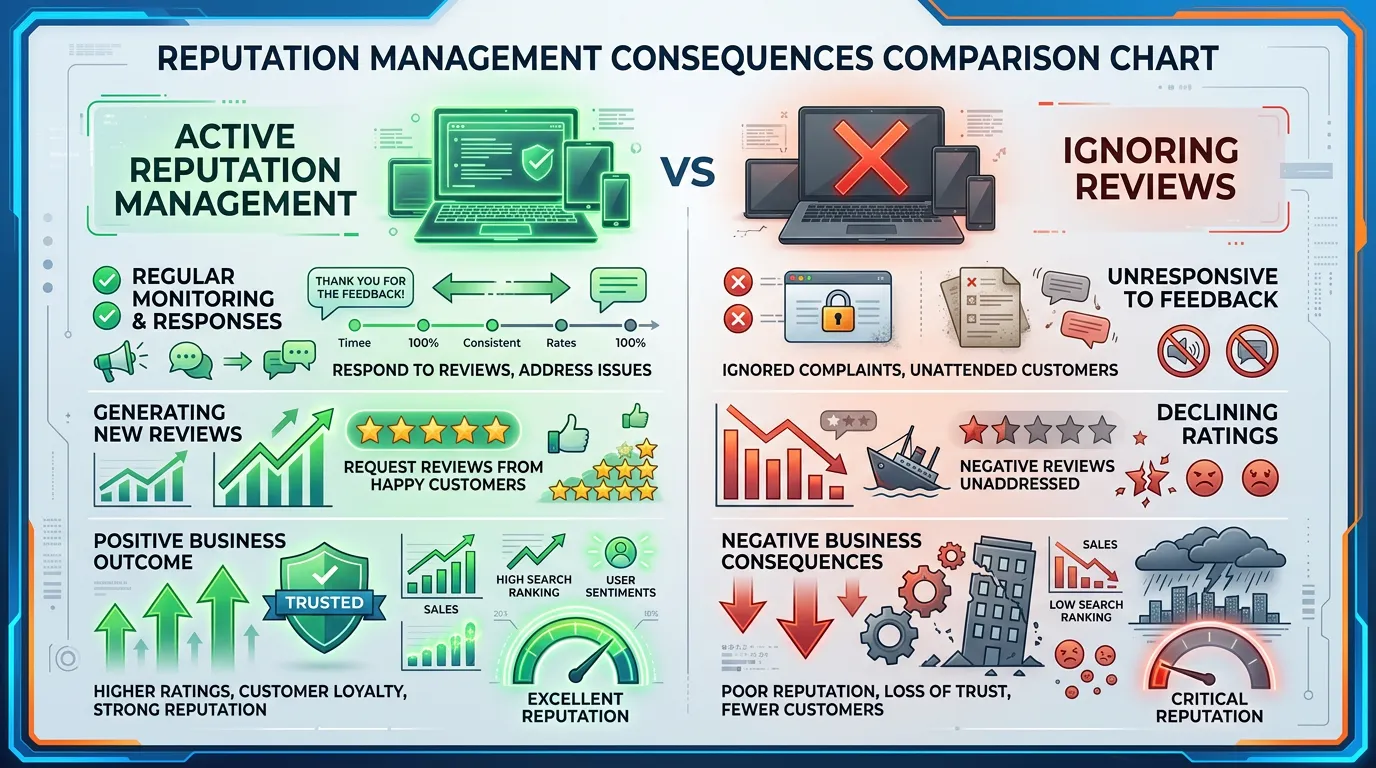
Active reputation management compared with Leaving reviews alone
Call (714) 823-3164 or ask a question. Clear recommendations, even if we never work together.
Reputation management means asking for reviews on purpose and replying to all of them. It also means watching every site where people talk about you. Ignoring reviews means taking whatever shows up. Managed profiles usually grow faster and hold a higher rating. Ignoring works only when your rating is already strong and reviews arrive on their own.
Our honest verdict
Doing nothing is a real strategy for some businesses. It works if you have a long waiting list, a 4.9 rating, and reviews arriving weekly without being asked. Almost nobody is in that position. For everyone else, the gap between managed and unmanaged shows up in the map pack within a few months. One warning: if the service itself has problems, asking more customers to review you makes those problems public faster. Fix the service first.
Side by side
| Criterion | Active reputation management | Leaving reviews alone |
|---|---|---|
| Review volume growth | A request after every job usually multiplies monthly review count several times over. | Whatever arrives on its own, often one or two a month at best. |
| Average rating over time | Trends up, because happy customers get asked instead of only angry ones. | Drifts down. Upset people are far more motivated to sit down and write. |
| Cost | $300 to $900 a month for a managed program, plus request software. | Nothing at all. |
| Time from your team | Somebody has to ask, and techs need reminding for the first few months. | Zero minutes. |
| Response to negative reviews | Answered within a day or two, calmly, with facts and an offer to fix it. | Sits unanswered, which most readers quietly take as agreement. |
| Effect on map rankings | Count, recency, and the words inside reviews all feed local ranking. | A stale review profile is a common reason a good business stalls in fourth place. |
| Risk of filtered reviews | A campaign run badly, in bursts or from one device, can trip filters and lose reviews. | Reviews that arrive naturally rarely get filtered out. |
| Policy exposure | Incentives and review gating break Google policy, so the program has to be built carefully. | No campaign means nothing to violate. |
| Coverage beyond Google | Yelp, Facebook, and industry sites get watched in the same place. | Most owners never see a Yelp review until a customer mentions it months later. |
| Handling a review attack | Flagging steps, documentation, and a response plan already exist before it happens. | Scrambling, usually a week after the damage is already visible. |
| How it reads to a customer | Steady recent reviews with thoughtful replies look like a business that is run well. | A slow drip of unprompted reviews can read as more organic to some buyers. |
| When service quality is inconsistent | Asking more people to review you exposes the weakness faster and in public. | Fewer eyes on the problem, though the problem does not go anywhere. |
A plus marks the side with the advantage on that row. If one column won every row, this would be an advertisement rather than a comparison.
Fix the Job Before You Ask About It
The verdict above says this in one line, and it deserves a paragraph. If your service has a real problem, a review campaign publishes that problem faster and to more people.
Before we start a request program we ask an owner four things. How long does it take you to call a new lead back? Do you give a two hour arrival window or a four hour one? Does the price on the invoice match the price you quoted? Does the crew clean up before they leave?
Those four cover most one star reviews in the trades. Not the work itself. The waiting, the surprise on the bill, and the mess. Fix them and the same campaign that would have hurt you starts helping.
Picture an owner whose crew misses appointments most weeks, asking for more reviews. More reviews would only be more evidence. That is not a reputation problem. It is a scheduling problem wearing a reputation problem's clothes.
What One Bad Review Actually Costs
This is arithmetic, not a scare tactic. It shows why volume is the only real defense against one angry customer.
| Where you are now | After one 1 star review | Five star reviews to get back |
|---|---|---|
| 5.0 stars, 10 reviews | 4.6 | 69 |
| 4.9 stars, 20 reviews | 4.7 | 19 |
| 4.8 stars, 50 reviews | 4.7 | 5 |
| 4.7 stars, 30 reviews | 4.6 | 7 |
| 4.6 stars, 15 reviews | 4.4 | 7 |
| 4.8 stars, 200 reviews | 4.8 | 0, the number does not move |
Rounded to one decimal, the way Google shows it. A perfect rating on ten reviews is the most fragile position there is.
A Review Request That Gets Answered
The gap between a five percent response rate and a thirty percent one is timing and who asks. It is almost never the wording.
Ask in person at the end of the job
The tech who fixed it holds the goodwill, not the office.
Send the link within an hour
Memory and gratitude both fade the same afternoon.
Send a text, not an email
Texts get opened. Service emails often do not.
Use the short review link, not your homepage
Every extra tap loses another share of people.
Follow up once, three days later, then stop
Two asks is helpful. Four is harassment.
Ask everyone, in order, every time
Picking only happy customers is review gating and breaks policy.
Track who has been asked
Otherwise the same regular gets asked five times a year.
Never send fifty requests at once
A sudden burst from one device can trip review filters.
Staying Inside the Platform Rules
The rules differ by platform, and the one that catches owners out is Yelp. Here is the short version.
Do this
- Ask every customer the same way, whether or not you think they are happy.
- Reply to the good reviews too. Two sentences and one specific detail is plenty.
- Screenshot any review you plan to report before it changes or disappears.
- Make it easy for unhappy customers to reach you, so the complaint arrives by phone first.
Not this
- Do not offer a discount, a gift card, a raffle entry, or a free filter for a review.
- Do not survey people privately first and send only the happy ones to Google.
- Do not solicit Yelp reviews. Yelp asks businesses not to, and asking can get you flagged.
- Do not have staff or family post reviews. It is easy to spot and it can cost you the profile.
- Do not argue the facts in public past one reply. Move it to a phone call.
The First Hour After a Review Attack
A review attack looks like several one star reviews in a day, often with no detail, sometimes from accounts with no other activity. It tends to follow a public dispute, a competitor having a bad month, or an unrelated news story.
Do not reply angrily and do not reply to all of them at once. First, screenshot every review with the date and the reviewer name visible. Then check your own records for each name. If they were never a customer, that is the ground you report on.
Report each one through the profile, separately, and pick the reason that fits: fake engagement, a conflict of interest, or content that is off topic. Then post one calm reply on each saying you have no record of the job and asking them to contact you directly.
Then keep asking real customers. Reporting works sometimes and fails often. New honest reviews are the part you control, and they push the damage down the page whether or not anything gets removed.