
Comparison
Local SEO vs Traditional SEO
Local SEO compared with Traditional SEO
Call (714) 823-3164 or ask a question. Clear recommendations, even if we never work together.
Local SEO competes for the map pack and searches tied to a place. Traditional SEO competes for standard organic links, often nationwide. Local leans on your Google Business Profile, reviews, and listings. Traditional leans on content depth and links. Service businesses need local first. Ecommerce and national brands need the other one.
Our honest verdict
If your customers have to be near you to buy, local SEO brings calls faster and cheaper, so it goes first. You will still need traditional SEO later. The content and links it builds are what let you compete outside your home city. They also help you hold your spot once the map pack tightens. If you sell online, ship nationwide, or serve clients anywhere by video, skip the local work and go straight to traditional SEO.
Side by side
| Criterion | Local SEO | Traditional SEO |
|---|---|---|
| What it competes for | The three map results and the local listings underneath them. | Standard blue links, featured snippets, and national rankings. |
| Distance from the searcher | A ranking factor you cannot change. Position shifts block by block across a city. | Barely matters. One page can rank the same in Chino and in Chicago. |
| Time to first movement | Often 60 to 90 days, because profile and listing fixes register quickly. | Usually 4 to 8 months, longer in crowded topics. |
| Main assets | Google Business Profile, reviews, citations, and real service and city pages. | Deep content libraries, full topic coverage, and earned backlinks. |
| Reviews as a ranking signal | Count, recency, and the words inside reviews all feed map position. | Reviews help people decide but do little for standard organic rank. |
| Backlink demand | A few dozen real local links are often enough in most trades. | Usually needs hundreds of links from higher authority sites. |
| Traffic ceiling | Capped by how many people near you search each month. There is a hard limit. | No geographic cap. One strong page can pull readers from everywhere. |
| Lead quality | High. Someone searching for a plumber near them is usually ready to call now. | Mixed. National traffic includes students, researchers, and other agencies. |
| Cost to compete | Lower in most trades. A real program runs $1,500 to $4,000 a month. | Higher. Content and link budgets in competitive topics run well past that. |
| How results get measured | Calls, direction requests, and map position sampled by coordinate. | Sessions, keyword position, and assisted conversions over time. |
| Effect of moving your office | A move can reset rankings across your whole service area for months. | An address change has almost no effect on anything. |
| Fit for multiple locations | Built for it. Each location gets its own profile, page, and review stream. | Works, but location level detail is not the problem it was designed to solve. |
A plus marks the side with the advantage on that row. If one column won every row, this would be an advertisement rather than a comparison.
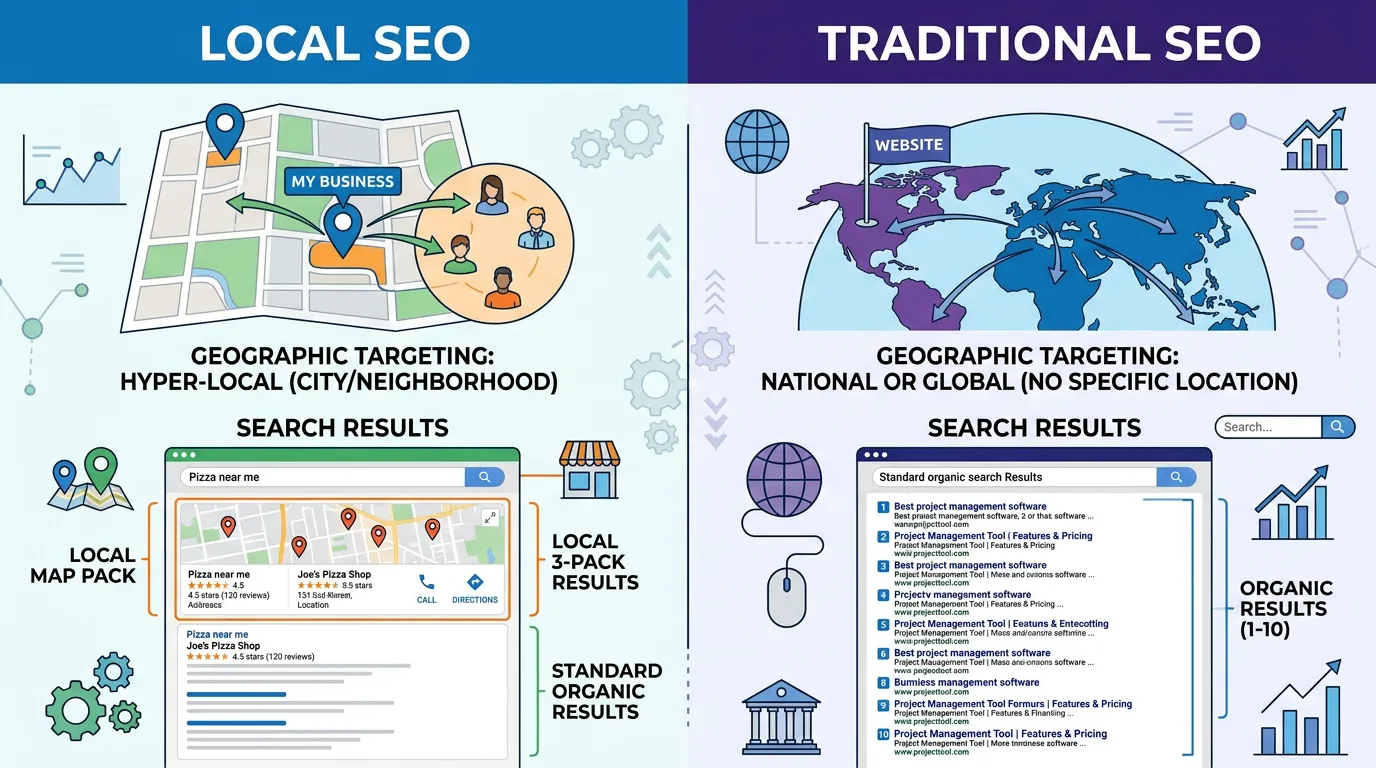
One Topic Splits Into Two Different Jobs
Take water heaters. Someone typing water heater repair Chino wants a phone number in the next ten minutes. Someone typing why is my water heater leaking from the bottom wants to know if the garage is about to flood. Same topic, two different jobs.
The first search is won with a Google Business Profile, reviews, and a service page for that city. The second is won with a clear article that answers the question and shows a photo of the part that fails. Local work will not rank that article. Traditional work will not put you in the map.
So the two are not rivals fighting over one budget. They cover different rows on the same page of results. The mistake is expecting one to do the other's job, then deciding that SEO does not work.
For a service business the order is local first, because the money search is the local one. Articles come later. The best ones answer the questions your phone already gets every week.
How One Results Page Is Stacked
A local search does not return one list. It returns several layers, and each layer is won a different way.
Local SEO fights for the middle two layers. Traditional SEO is how you reach the bottom one and how you get past directories.
Which One Fits Your Business
Find the line closest to how you actually make money. For plenty of businesses the right answer is not the local one.
| Business | Start with | Why |
|---|---|---|
| Plumber serving four cities | Local | Every buyer has to be within driving distance |
| Online store shipping nationwide | Traditional | There is no map pack to win |
| Therapist doing video sessions statewide | Traditional | Your client never has to be near you |
| Dental office with one building | Local | Almost all patients live within a few miles |
| Manufacturer selling to buyers anywhere | Traditional | Buyers search by part and spec, not by city |
| Law firm taking local and statewide cases | Both | Local for walk ins, content for the bigger cases |
| Restaurant | Local | Nobody drives ninety minutes for lunch |
| Software or a course sold online | Traditional | Local signals do nothing for you at all |
If a customer can buy from you without being near you, local SEO is the wrong first spend.
Signs You Have Outgrown Local Only
Local work has a ceiling, and it is set by how many people near you search each month. These are the signs you have reached it.
You already appear in the map pack for your main terms
More profile work has little room left to gain.
Rankings hold but call volume is flat for two quarters
You are taking your share of a pool that is not growing.
You want to sell a product, not a visit
Shipping a part has no distance limit on it.
You are opening in a city you have no address in yet
Content can arrive months before a location does.
Competitors outrank you on question searches
Those searches reach the buyer six months early.
You turn down calls from outside your service area
That demand is real and someone else is serving it.
You want to sell the business in a few years
Content and links transfer to a buyer. Proximity does not.
Running Both Without Wasting the Budget
Most of the money lost here goes to duplicate pages and to pages written for search engines instead of customers.
Do this
- Give each city page real content: a local job, the streets you cover, the permit office you deal with.
- Point every article at the service page it supports, and point that page back at the article.
- Build one page per service per city only where you truly send a truck.
- Check which of your pages Google already picked for a search before you write another one for it.
Not this
- Do not clone a page and swap the city name. Google treats those as one page, at best.
- Do not build pages for forty cities you cannot reach in an hour.
- Do not write national guides before your own service pages explain what you charge and how you work.
- Do not chase a keyword with big volume and no buying intent because a tool made it look important.