
Comparison
Full Service vs Single Channel
A full service marketing partner compared with One channel done well
Call (714) 823-3164 or ask a question. Clear recommendations, even if we never work together.
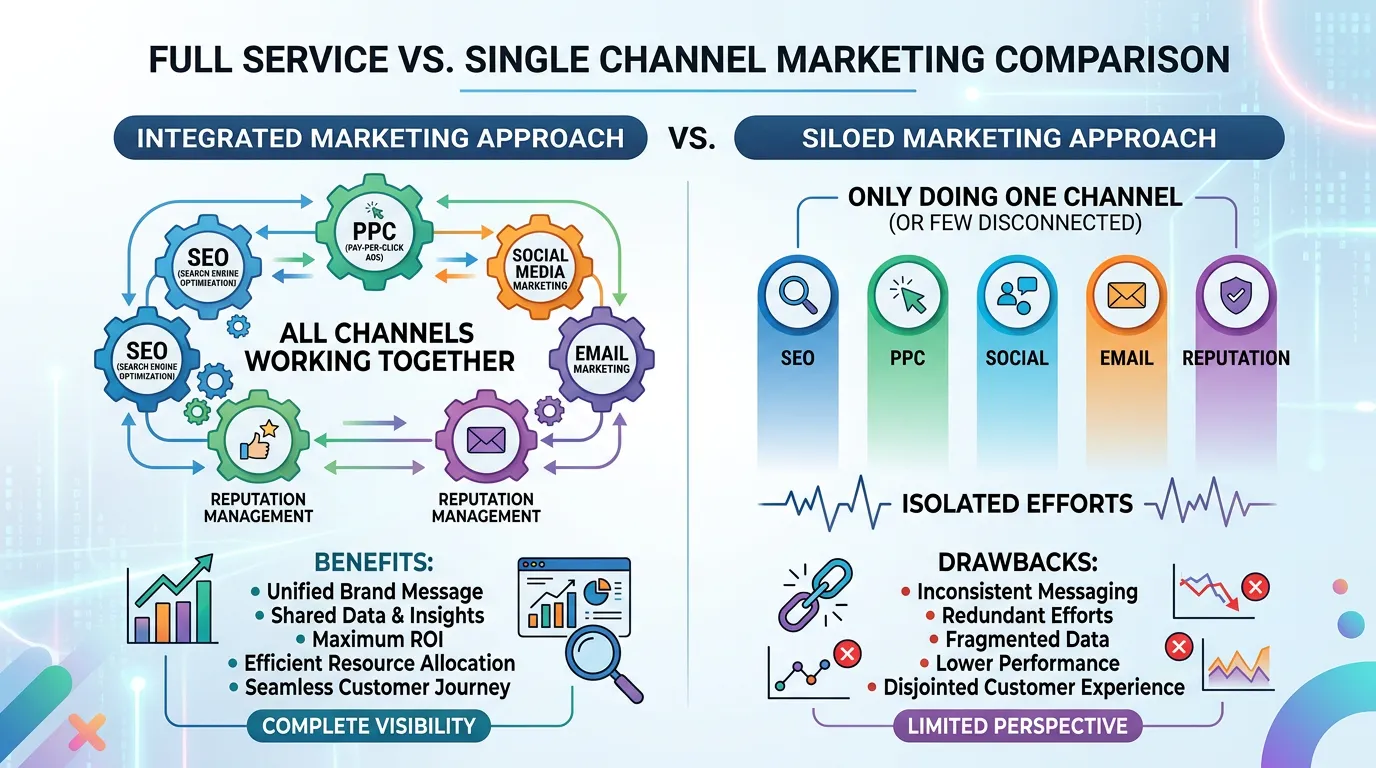
Full service means one team running SEO, ads, website, reviews, and email together. Single channel means hiring one specialist for one job. Full service wins when the channels depend on each other and nobody in house is tying them together. Single channel wins on cost and depth. It also makes it easier to tell whether the money worked.
Our honest verdict
Under about $2,500 a month, one channel done properly beats five channels done thinly. It is also far easier to judge. Full service earns its keep once the pieces start blocking each other. That looks like ads sending traffic to a slow page, SEO producing calls nobody follows up on, or reviews sitting unanswered while the profile stalls. If you already have a marketing manager who can manage specialists, hiring specialists is usually the cheaper path.
Side by side
| Criterion | A full service marketing partner | One channel done well |
|---|---|---|
| Monthly cost | $3,500 to $10,000 depending on how many channels are running at once. | $800 to $3,000 for one channel handled well by one shop. |
| Depth in any one channel | Strong across the board, rarely the deepest specialist in any single discipline. | A dedicated PPC or SEO shop usually goes deeper than a generalist can. |
| Coordination between channels | One team, one plan. Ad landing pages and SEO pages stop competing with each other. | Falls to you. Two vendors will each blame the other when results go flat. |
| Attribution and reporting | One tracking setup, one report, one place the numbers come from. | Each vendor reports its own wins. Double counted leads are normal. |
| How easy it is to judge results | Harder. When five things change at the same time, credit is difficult to assign. | Clean. Spend went in, leads came out, and you can read it in a month. |
| Speed of the first fix | Website, tracking, and profile problems get handled without waiting on a second vendor. | Waiting on a web developer who has twelve other clients is a common stall. |
| Switching cost | Replacing a full service partner means replacing everything at once. | Fire one vendor and keep the rest running without interruption. |
| Your time managing vendors | One call, one contact, one invoice, one plan to keep track of. | Three vendors means three calls, three reports, and you as the referee. |
| Fit for a small or seasonal budget | Spreads thin. Five channels at $500 each accomplishes very little in any of them. | All the budget lands in one place, which is where results come from. |
| Coverage of the boring work | Schema, tracking, listings, and page speed are somebody's job by default. | Falls between vendors. Broken conversion tracking can run for months unnoticed. |
| Consistency of message | One voice across ads, website, video, and email. | Drifts, because every vendor writes in its own style. |
| Access to senior people | Depends entirely on the agency. Larger shops hand you a junior account manager. | Small specialists often put the owner directly on your account. |
A plus marks the side with the advantage on that row. If one column won every row, this would be an advertisement rather than a comparison.
The Third Option Nobody Puts in the Comparison
This page weighs one agency against several specialists. There is a third choice, and it belongs in the math: hire someone.
A full time marketing coordinator costs more than the salary. A common rule of thumb is to add twenty five to thirty five percent for payroll taxes, insurance, and benefits. Then add software, training, and your own hours managing a person who has never done this job before.
Where a hire wins is availability and knowledge. They sit in your office, learn the trade properly, and can be pulled onto anything that comes up. Where a hire loses is depth. One person cannot be strong at technical SEO, paid ads, video, and email at the same time, and the ones who are get expensive.
The pattern that works for most businesses under about twenty employees is one coordinator plus one or two specialists. The coordinator owns the calendar, the follow up, and the customer knowledge. The specialists do the work that needs a tool nobody in house is going to buy.
Who Owns the Work Nobody Wants
Most marketing problems come from jobs sitting between two vendors. Settle these before you sign anything.
| The job | Full service | Specialists | What goes wrong |
|---|---|---|---|
| Conversion tracking | One team, one setup | Nobody by default | Broken for months, nobody notices |
| Landing page speed | Included | Split with your web person | Ads pay for clicks the page loses |
| Google Business Profile | Owned | Often just assumed | Hours and services go stale |
| Call routing and recording | Set up once | Rarely covered | Leads counted twice or not at all |
| Moving budget between channels | One decision | Two arguments | Money stays where it is losing |
| Schema and technical fixes | Routine | Depends on scope | Falls to whoever is cheapest to ask |
The fix is not always a full service contract. It can be one sentence in each specialist's scope naming the owner.
Telling a Real Team From a Reseller
Plenty of full service shops sell the work and send it elsewhere. That is not always a bad thing. Not knowing is.
Ask which channels are done in house
An honest answer names one or two that are not.
Ask to meet the person inside the ad account
Not the account manager. The person doing the work.
Ask where the reporting numbers come from
A white label dashboard is a hint, not proof.
Ask what happens to a rush request on a Friday
Subcontracted work sits in a queue you cannot see.
Ask for the scope in writing, per channel
Vague scope is how the boring work goes missing.
Ask what they will not do
A team that says it does everything usually does not.
Ask how many clients each specialist carries
Twenty accounts per person means thin hours on yours.
Running Specialists Without Becoming the Referee
If you go the specialist route, the coordination problem is real but it is solvable. This is how owners handle it well.
Do this
- Put every vendor on one shared analytics and call tracking account that you own.
- Hold one thirty minute call a quarter with all of them on it at the same time.
- Write down which vendor owns the website, in one sentence, and send it to everyone.
- Agree on one definition of a lead in month one and make all reports use it.
- Give each vendor read access to the others' results so nobody claims the same call twice.
Not this
- Do not let two vendors write pages for the same service without telling each other.
- Do not let anyone build on a platform or an account you do not control.
- Do not accept a report that shows only the numbers that vendor influences.
- Do not add a third vendor while two of them are still blaming each other.
The Order to Add Channels
This sequence wastes the least money for a local service business. Each step should be producing before the next one starts.
A business that needs revenue this quarter flips the first two steps and starts with ads. This is a default, not a rule.
Scope and Contract Questions
Can I hire a full service agency for only two channels?
My web developer is a family member. How does that work?
What if one channel is clearly failing?

Frequently asked questions
How do I know when I need more than one channel?
Is it cheaper to hire a specialist for each channel?
Which single channel should a service business start with?
Can I add channels one at a time?
What is the realistic minimum budget for full service?