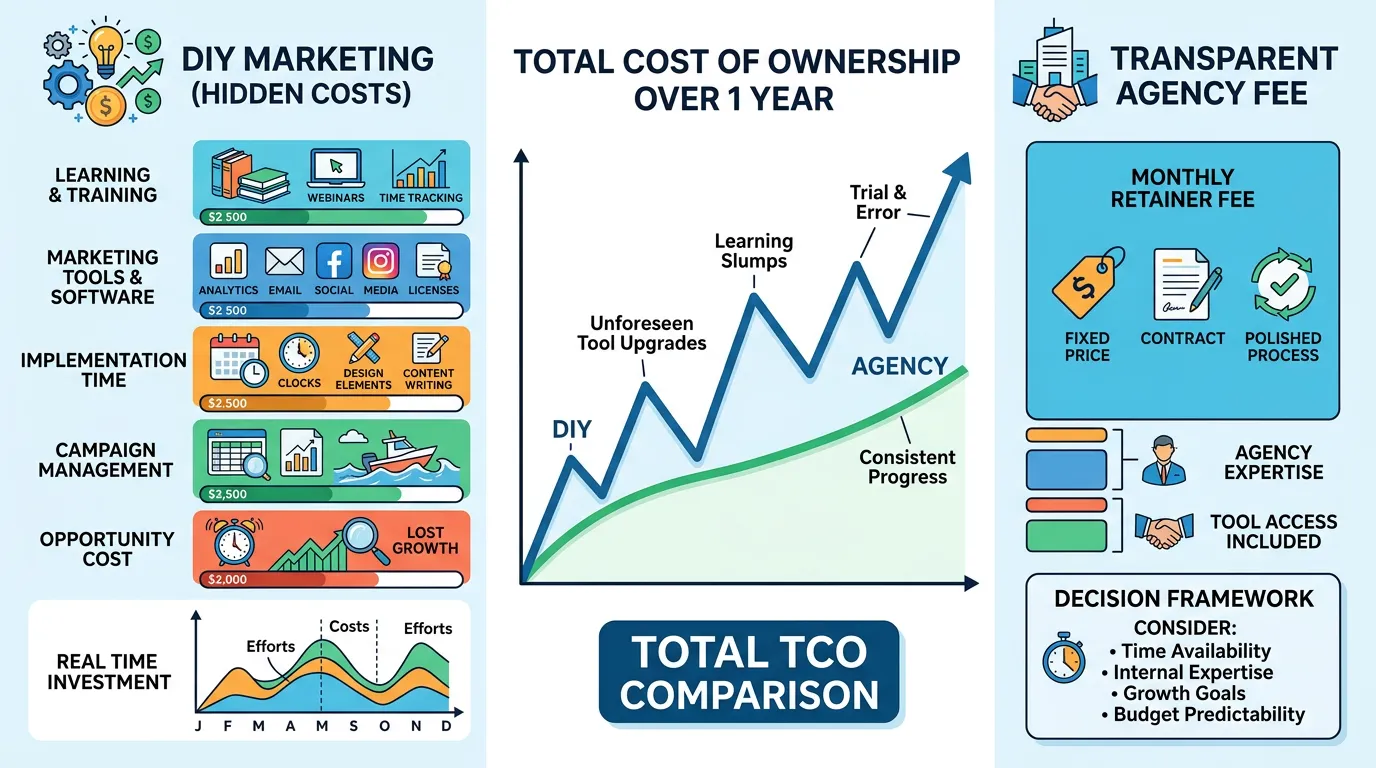
Comparison
Agency vs DIY
Hiring a marketing agency compared with Doing your marketing yourself
Call (714) 823-3164 or ask a question. Clear recommendations, even if we never work together.
Hiring an agency buys experience, tools, and consistent hours every month. Doing it yourself saves cash and keeps full control. Agencies usually win on speed and technical depth. Owners with time, patience, and a small service area can absolutely handle the basics themselves. The right answer depends on your budget and your free hours.
Our honest verdict
If you have more time than money, DIY is a real option. Plenty of owners run a solid Google Business Profile without help. Hire an agency when the work has outgrown your calendar. Hire one when the technical side has stalled you, or when a month of drift costs more than the fee. The worst outcome is the middle. That means paying an agency and still trying to run it yourself, or starting DIY and quitting after six weeks.
Side by side
| Criterion | Hiring a marketing agency | Doing your marketing yourself |
|---|---|---|
| Monthly cost | Usually $1,500 to $5,000 a month, depending on scope and how many cities you compete in. | Software and listing tools run roughly $50 to $300 a month. Your own labor is the real cost. |
| Your time each month | Two to four hours: a review call, a few approvals, and answering questions about the work. | Ten to twenty hours a month to do it properly, and the work never really stops. |
| Speed to first results | Usually 60 to 90 days for first movement, because the sequence is already known. | Often 6 to 12 months, since most of year one goes to learning what actually matters. |
| Technical work | Schema, site speed, indexing, call tracking, and conversion setup are routine tasks. | Most owners stall here. Broken or missing tracking is the single most common DIY problem. |
| Knowing your customers | We learn it from you, and it takes a few months to get the language right. | You already know the objections, the seasons, and the sentence that closes a job. |
| Control over decisions | You approve, we execute. Changes go through a person and usually take a day or two. | You change what you want, when you want, with nobody to ask first. |
| Consistency over twelve months | The work happens in July whether or not you are buried. That steadiness is the product. | Almost always drops off during busy season, which is exactly when it compounds. |
| Tools and data | Geogrid rank tracking, call tracking, audit tools, and competitor data are already paid for. | Free tools cover the basics. The paid ones cost more than one business can justify. |
| Risk of a costly mistake | Fewer suspensions and penalties, though you are trusting somebody else's judgment. | Profile suspensions, duplicate listings, and review policy violations are common. |
| Writing that sounds like a real person | Good agencies interview you and match your voice. Weak ones publish generic filler. | Your writing sounds like you, though most owners never get around to writing anything. |
| Skill you keep | You learn what works, but the how stays with the agency when the contract ends. | Everything you learn stays inside the business permanently. |
| Fit for a tight budget | Below roughly $1,000 a month, an agency cannot do enough hours to move anything. | Works at any budget. Even a few free hours a week produces something. |
A plus marks the side with the advantage on that row. If one column won every row, this would be an advertisement rather than a comparison.
The Cost of Your Own Hours
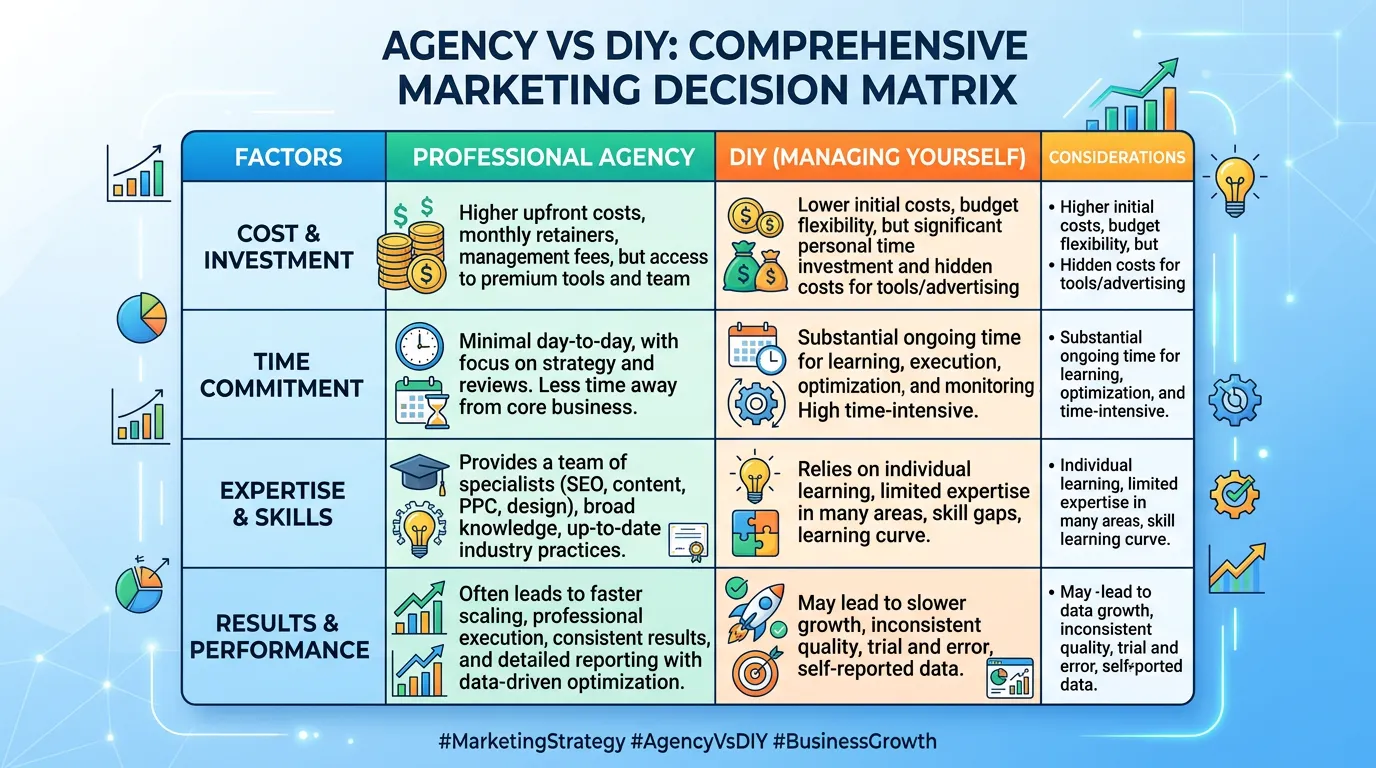
Most DIY comparisons stop at the software bill. That is the small number. The real cost is the ten to twenty hours a month, and those hours come out of somewhere. Usually they come out of estimating, hiring, or the one evening a week you were not working.
Put a number on it. Take what your business bills in an hour, or what you would pay someone to cover the work you skipped. Multiply that by fifteen hours. If the answer is close to an agency fee, DIY is not saving you money. It is moving the cost somewhere you do not track.
The other half is the learning curve. The first three months of DIY are not marketing. They are reading, testing, and undoing mistakes. That is a fair trade if you plan to keep the skill for years. It is a bad trade if you plan to hire someone in six months anyway.
None of this makes DIY wrong. It means the honest comparison is not $200 against $2,500. It is $200 plus your hours against $2,500 plus a few hours of review calls.
What a Real DIY Month Looks Like
This is the work, not the theory. Every line below is something an owner can do alone. Add the hours up before you decide.
| Task | How often | Time each month | What happens if you skip it |
|---|---|---|---|
| Ask every customer for a review | After each job | 1 to 2 hours | Review growth stops and the profile goes stale |
| Reply to every review | Weekly | 30 to 60 minutes | Readers quietly assume the complaint is true |
| Add photos to your profile | Weekly | 1 hour | You look dead next to the profile beside you |
| Write or update one page | Monthly | 3 to 5 hours | You compete for fewer searches each year |
| Check listings for wrong data | Monthly | 1 hour | An old phone number keeps sending calls elsewhere |
| Read your call and form data | Monthly | 1 hour | You spend the next month on the wrong service |
| Check rank from a few points | Monthly | 1 hour | You only ever see your own block, not the city |
Ten to twelve hours in a slow month. Busy season is when it stops, and busy season is when it compounds.
If You Are Doing It Yourself, Do It This Way
We would rather you do this well than hire us badly. Here is the short list we give owners who tell us they are not ready to pay anyone.
Do this
- Pick three services and three cities. Go deep on those before you add a fourth of either.
- Set up conversion tracking on day one, even if it is just a tracked number on the contact page.
- Ask for the review at the door, before you leave the job, with the link already on the invoice.
- Block ninety minutes on the same day every week and treat it like a scheduled job.
- Write your service pages the way you explain the work on the phone. That voice already sells.
Not this
- Do not buy a listings package that promises a hundred directories. Ten real ones beat a hundred junk ones.
- Do not add city pages you cannot fill with real detail. Thin copies of one page help nobody.
- Do not put keywords in your business name. That is the fastest route to a suspension.
- Do not judge your rankings from your own phone. Your location and history show you results nobody else sees.
- Do not stop in July. Four months on and eight months off produces almost nothing.
What to Ask Before You Sign With Any Agency
These questions get honest answers on a first call. Ask them before anyone talks about price.
Who actually does the work?
Ask for names and roles, and ask what gets sent to a subcontractor.
What is the notice period?
Month to month or ninety days changes your risk more than the fee does.
Who owns the site, the profile, and the tracking?
The answer should be you, in writing, on every single one.
What gets published in a normal month?
A number and a type of work. Not a promise about impressions.
How does a call get counted as a lead?
Ask whether a thirty second hangup counts. In many reports it does.
What happens in the first ninety days?
Ask what week one looks like, specifically, before setup fees are paid.
Can I see a report from a current client?
Names blacked out is fine. Refusing to show any format at all is not.
What would make you tell me to stop paying?
An agency with no answer here has never turned down money.
Contracts, Handoffs, and the Middle Path
What happens to the work if I cancel?
Can I hire an agency for setup and then take over myself?
Is a cheap $500 a month plan ever worth it?
Frequently asked questions
How much does a marketing agency cost for a small service business?
Can I really do local SEO myself?
What should I keep doing myself even if I hire an agency?
How do I tell whether an agency is doing real work?
When is DIY clearly the wrong choice?