
Free calculator
Review Generation ROI Calculator
See what closing the review gap with your competitors is likely worth.
Call (714) 823-3164 or ask a question. Clear recommendations, even if we never work together.
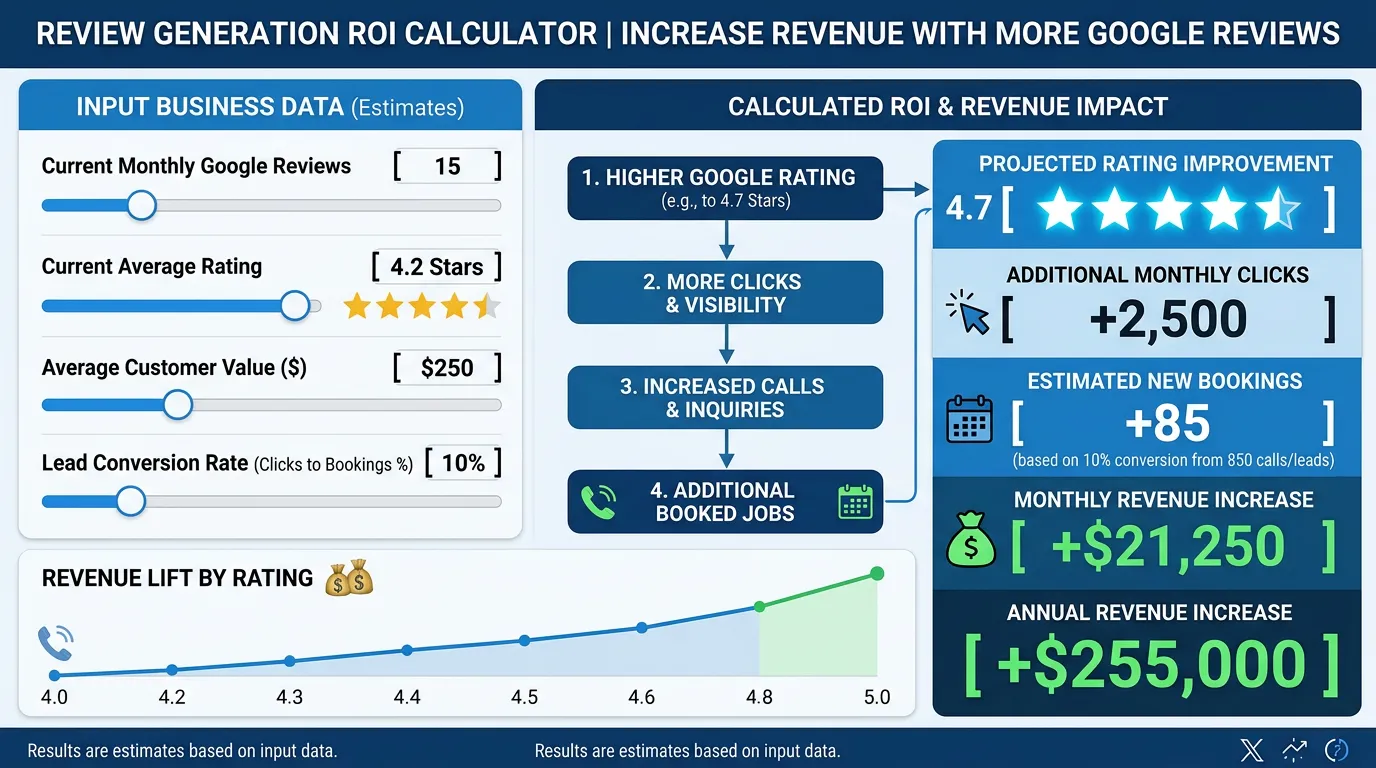
This calculator estimates what closing the Google review gap is worth. Review count and rating influence both map pack position and whether someone calls you rather than the business next to you, so the model combines a visibility lift with a click through lift and converts the result into annual revenue.
Your numbers
Change anything. The result updates as you type.
Estimated annual upside
$24,835
- Reviews behind
- 73
- Estimated call lift
- 39%
- Extra calls per month
- 7
- Extra jobs per year
- 29
- Value per review earned
- $340
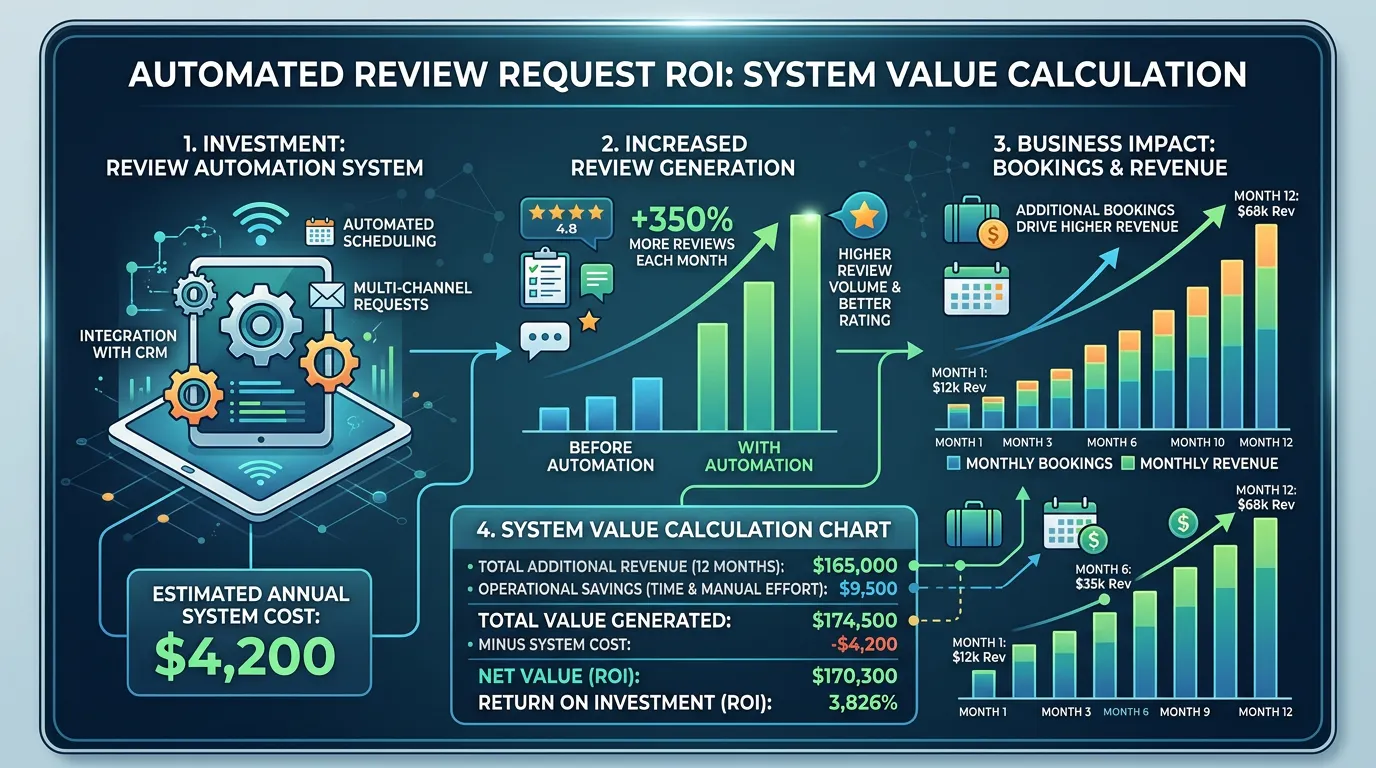
You are 73 reviews behind the business above you. Closing that gap is worth roughly $340 per review earned. Most service businesses can close a gap this size in six to nine months with a system that asks every satisfied customer.
The math
gap ratio = current / competitor; lift = (1 - gap ratio) x 0.45; extra annual revenue = monthly calls x 12 x lift x close rate x job value
Assumptions
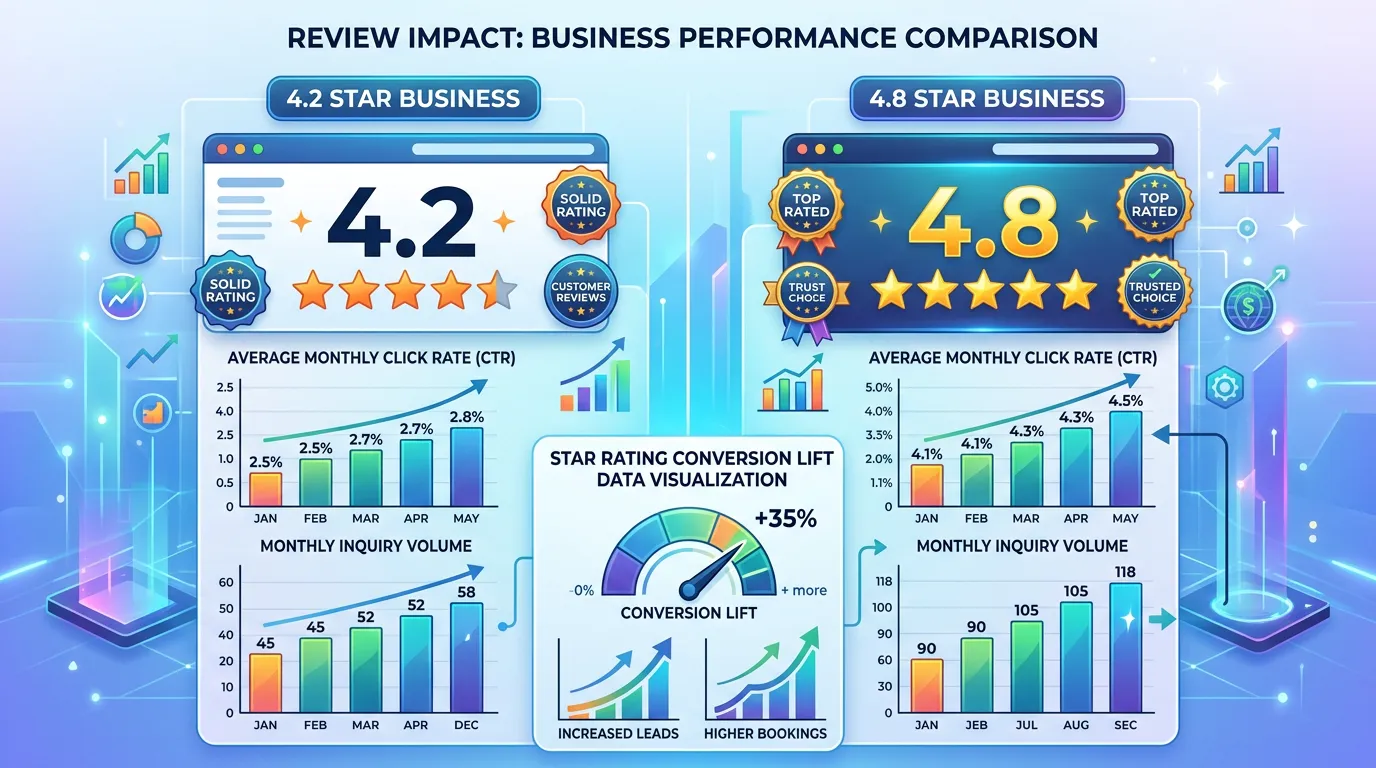
- A business at parity on reviews captures roughly 45 percent more calls than one far behind, blending the visibility effect and the choose-me effect.
- The lift is proportional to how far behind you are. Being already close to parity leaves little room to gain.
- Rating is assumed to stay at or above 4.5. Volume does not help if the average drops.
- Reviews influence ranking alongside relevance, distance, proximity, and profile completeness. They are one factor, not the only one.
This is an estimate, not a forecast. It is only as good as the numbers you put in.
Why velocity matters more than total
A business with two hundred reviews where the last one arrived eight months ago looks worse to Google, and to a customer reading the profile, than a business with sixty reviews where four arrived this month. Total count signals history. Velocity signals that the business is currently operating and currently doing good work. Both matter, and velocity is the one most businesses ignore because it requires a system rather than a push.
Volume does not fix a bad average
This calculator assumes your rating stays at or above 4.5. Below roughly 4.2, additional reviews stop helping and start confirming a pattern, because a visitor reading the profile sees consistency rather than an outlier. If your average is under that, the work is operational before it is marketing: find what is generating the complaints, fix it, and then start asking. Asking for reviews while the underlying problem is live just produces more evidence of the problem.
Asking without being awkward about it
The best moment is immediately after the customer expresses satisfaction, in person, while your technician is still there. A text message sent within an hour of that moment, containing one sentence and a direct link, outperforms an email sent three days later by a wide margin. What kills review programs is not the ask, it is the friction: any request that makes someone search for your business, log in, and navigate to the right screen loses most people at the first step.
Frequently asked questions
Is a 45 percent lift realistic?
Can I offer a discount for a review?
What do I do about a bad review?
How long does it take to close a review gap?
What each input actually means
Your current review count is the number on your Google Business Profile today, not your total across Google, Yelp, and Facebook. This model is about map pack position, so only Google reviews belong here.
The top map pack result means the business that shows first when you search your main service plus your city. Do that search on a phone, standing inside the area you serve. Distance changes what Google shows you.
Calls per month from Google is a real figure in your profile, not a guess. Close rate and job value are the same inputs the other calculators use, so reuse those figures and keep the answers comparable.
Getting your five numbers in ten minutes
Every input is free to see. You need no tool beyond your own profile.
Open your Business Profile on Google
Search your own business name while signed in as the owner.
Write down your review count and your average
Both sit right under the business name at the top of the profile.
Search your main service plus your city
Use a phone, out in the area you serve, so distance is realistic.
Record the top result's review count
Tap the first map listing and read its review total.
Open Performance in your profile
Set the range to last month and read the calls figure.
Reuse your close rate and median job value
Jobs divided by answered calls, and the middle invoice from last year.
What the size of your gap is telling you
The size of your gap changes what to work on next. These are common patterns, not fixed rules, and they vary by trade and city.
| Your count against the leader | What it usually means | First move |
|---|---|---|
| Under a quarter of theirs | Hard to find, and easy to skip past | Build the asking routine before anything else |
| About half of theirs | You show up, but lose the click | Raise your monthly pace and reply to every review |
| Close to level | Reviews are not what holds you back | Check photos, services listed, and response time |
| Ahead of them | Your risk is going quiet | Keep a steady pace so the profile stays active |
Reviews are one ranking factor among several. A large gap usually matters. A small one usually does not.
Reading your result
The line to watch is value per review earned. It turns a vague chore into a price. If one review is worth two hundred dollars in future work, a thirty second text after every job is worth sending.
The lift percentage shrinks as the gap closes, and that is correct. Going from twelve reviews to sixty changes what a customer sees. Going from two hundred to two hundred and fifty changes almost nothing.
A small result is useful, not a disappointment. It means reviews are not your bottleneck, and the money belongs somewhere else on the profile or on the website it points at.
What actually changes the number
Review gaps close through a routine, not a campaign. These habits move the count, and these stall it.
Do this
- Ask in person, the moment the customer says they are happy.
- Send the link by text within an hour, while the job is fresh.
- Use a short link that opens the review box, with no searching or menus.
- Reply to every review, good and bad, within a day or two.
Not this
- Do not offer money, a discount, or free work for a review.
- Do not blast a batch of requests at old customers in one week.
- Do not pick who you ask based on who seems likely to be kind.
- Do not push for volume while your average rating is falling.