Service area
Local SEO and Internet Marketing in Southern California Service Areas
Based in Chino. Serving service businesses across San Bernardino County, Riverside County, Los Angeles County, Orange County.
- Cities covered
- 15
- Counties
- 4
Call (714) 823-3164 or ask a question. Clear recommendations, even if we never work together.
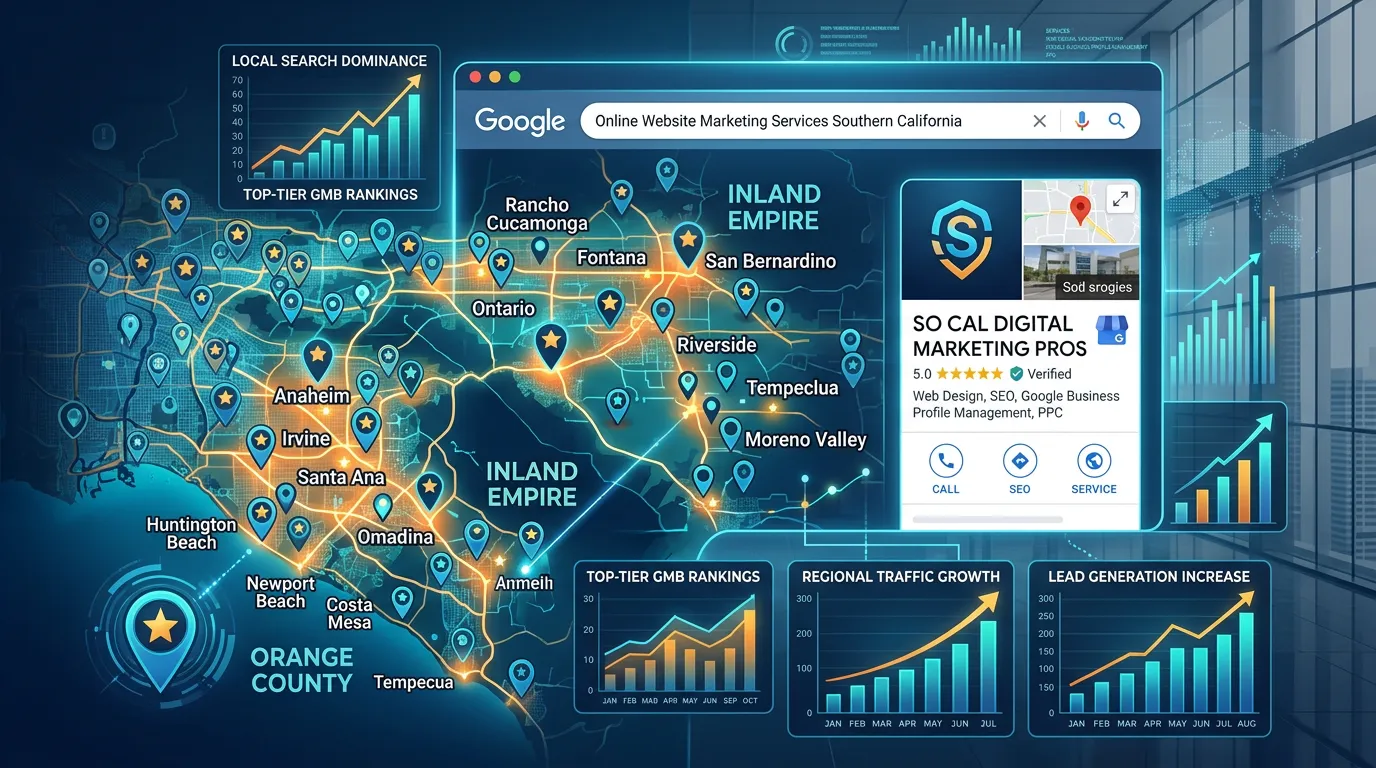
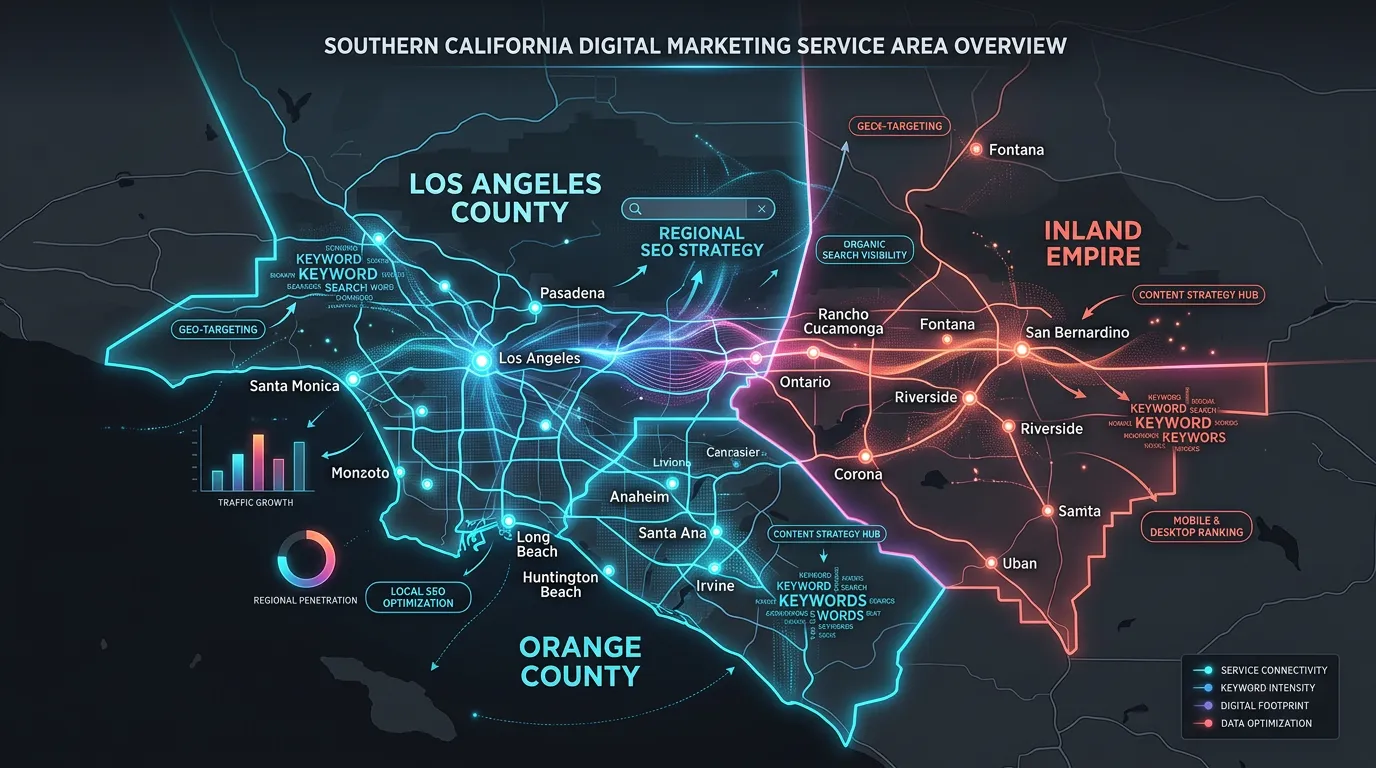
Online Website Marketing serves service businesses across four Southern California counties: San Bernardino, Riverside, Los Angeles, and Orange. Our footprint runs from Rialto in the east to San Clemente on the coast. The two ends sit about eighty miles apart by road. We work in thirty six named cities and the communities around them.
Southern California is one connected metro that happens to have county lines drawn through it. People live in Eastvale, work in Irvine, and call a contractor from the 91 on the drive home. Our footprint follows that reality. It is four counties, from Rialto in the east to San Clemente on the coast, tied together by the 10, the 15, the 60, the 57, the 91, and the 5. Three things shift as you move across that footprint, and each one changes what a marketing program has to do. Cost climbs toward the coast. The same home service keyword can cost several times more per click in Newport Beach than in Rialto. Map pack leaders in Orange County often hold three or four times the review count of their Inland Empire counterparts. Radius shrinks toward the coast as well. Inland cities are large and spread out, so one verified address can cover real ground. Orange County cities are small and packed. There the practical map radius is a few miles, and you need a genuine presence in the cluster you want to win. Language changes by city rather than by county. Spanish matters in Pomona, Ontario, Santa Ana, and Anaheim. Vietnamese matters in Garden Grove. Mandarin and Korean matter in Diamond Bar and parts of Irvine. What does not change is how Google decides. It weighs relevance, distance, and prominence, everywhere. Only the amount of prominence required moves. We use drive time, average job value, and competitor review counts to pick your city list. That tells us which cities deserve a page and a budget, and which ones you are better off leaving alone.
Cities we serve here
What we do
Google Business Profile Optimization
Turn your profile into the strongest lead source you own.
Google Business Profile OptimizationReputation Management
Generate reviews on purpose and protect the rating you have.
Reputation ManagementPay Per Click Advertising
Paid traffic that produces calls instead of clicks.
Pay Per Click AdvertisingWeb Design and Development
Fast, accessible websites built to turn visits into calls.
Web Design and DevelopmentLead Generation Systems
Capture, track, and follow up on every inquiry automatically.
Lead Generation SystemsSocial Media Marketing
Social proof that supports the sale instead of random posting.
Social Media MarketingConversion Rate Optimization
Get more calls from the traffic you already have.
Conversion Rate OptimizationEmail and Marketing Automation
Follow up every time, without anyone remembering to.
Email and Marketing AutomationGenerative Engine Optimization
Get named when someone asks an AI who to call.
Generative Engine OptimizationDigital Marketing Strategy
Know which channels deserve your budget before you spend it.
Digital Marketing Strategy

The three numbers, and the cutoffs we use
Drive time, job value, and competitor reviews decide the city list. These are the rough cutoffs we work from when we run them.
| Number | How to get it | Looks good | Looks bad |
|---|---|---|---|
| Round trip drive time | Map it at eight in the morning and four in the afternoon | Under an hour | Over ninety minutes |
| Average job value there | Your last twenty invoices from that city | Covers the drive and still profits | Small service calls only |
| Map pack review counts | Search from that city center, not your desk | Reachable in a year of asking | Several hundred ahead of you |
| Calls you can answer | Your own schedule and staffing | Same day | Next week at best |
These are rules of thumb, not laws. A high value trade can justify a long drive. A small flat rate service call almost never can.
One brand, four counties, one phone number
Owners often want a different phone number for each city so they can see what is working. That is fine on the website, where a tracking number can swap in by page or by ad click.
Leave the profile number alone. The number on your Google Business Profile should match your contact page, your invoices, and your listings. Swapping it around is a common cause of scattered listings and lost calls.
You do not lose the data either. Your profile reports the calls it sends you, and your ad account reports calls from ads. Between those two you can still tell which city is producing work.
One more rule. If you open a second office in another county, that location gets its own number, its own page, and its own profile. Never share one number across two verified addresses.
How we decide which county gets the budget
The order of these steps is the whole trick. Most bad city lists come from picking the cities first and checking the numbers later.
Redo this once a year. A new crew, a new office, or a slow season can move a city from the wait list into the plan.
What a four county report should show every month
If a report cannot answer these, it is a traffic chart, not a business report.
Map rankings by city, from points across the area
Not one check from the office
Calls split by city and by source
Ads, profile, and site apart
Forms and texts, not only calls
Younger buyers rarely dial
New reviews and the running average
Per location if you have two
Which pages brought people in
City pages listed by name
Ad cost per booked job
Not cost per click
What changed on the site this month
A plain dated list
What comes next, and why
One short paragraph
A city you drive to twice a year does not need a page. It needs a phone number and an honest quote.
Covering a wide area without looking thin
The risk with a large service area is not that Google punishes ambition. It is that the pages end up saying nothing. Forty pages that differ only by a place name read as forty copies of one page, because that is what they are.
A page earns its place by carrying something true about that town: what is built there, what breaks there, how far people will travel, who else is competing. If you cannot write three specific sentences about a place, you probably should not have a page for it yet.
That is a slower way to build coverage, and it is the only one that holds up. Better to have twelve pages that each say something than forty that say the same thing twelve different ways.
Questions about wide service areas
Is it better to have one service area page or one page per city?
How long before a new city page ranks?